- Main article: Forestry
For formatting with FULL TAXONOMIC CLASSIFICATION, similar to the Fossil List, go to Tree List/Full Taxonomic Classification.
Asterisks
Single Asterisk
*Are not in the National Audubon Society Trees of North America, 2021 Edition.
Cactaceae: Cactus Family
Carnegia gigantea (Saguaro)
Agavaceae: Yucca Family
Yucca brevifolia (Joshua Tree)
Euphorbiaceae: Spurge Family
Aleurites moluccanus (Candlenut)
Triadica sebifera (Chinese Tallow)
Double Asterisk
**Trees with two asterisks have had a scientific name change since the 2023 list, or the publication of the National Audubon Society Trees of North America, 2021 Edition.
Fagaceae: Beech Family
Lithocarpus densiflorus >>> Notholithocarpus densiflorus (Tanoak)
Quercus michauxii >>> Quercus montana' (Chestnut Oak)
Ginkgoaceae
Introduction to Ginkgo
| Ginkgo
|
|
| Info
|
Detailed Information
|
| Family
|
Ginkgoaceae
|
| Species
|
Ginkgo biloba
|
| Identification tips
|
Distinct fan-shaped semicircular leaf 2-6 inches wide.
|
| Region
|
Most common in the northeastern states.
|
Endangered
|
The Ginkgo is a living fossil and one of the most unusual trees in the world. The genus is known from fossils that date back 270 million years and are nearly identical to present-day trees. The Ginkgo is classified not only in its own family, but in a separate division of the kingdom Plantae. The fruit produced by female Ginkgo trees is technically a naked seed with a fleshy outer coat like a yew. Extracts of Ginkgo leaves have long been used medicinally, and some modern studies suggest that they may have a few potentially beneficial effects, such as improving blood flow. The wood of ginkgos has never been used commercially, but the seeds are a popular specialty food item in asia. The species is important as an ornamental tree with very high tolerance for the confined spaces and pollution of cities.
Ginkgo biloba (Ginkgo)
Ginkgo is a unique gymnosperm in the monotypic family Ginkgoaceae. It is also classified in it's own division of Plantae, Ginkgophyta, as opposed to Pinophyta or Magnoliophyta. It is a well known example of a living fossil, although several other species in the Ginkgo genus have also been found in the fossil record. Ginkgo fossils first appeared in the Early Jurassic and became widespread throughout Laurasia, but they disappeared at the end of the Pliocene (about 2 mya) except for in a small area of central China. Today they are widely cultivated around the world, although they are classified as endangered by the IUCN due to their small natural range.
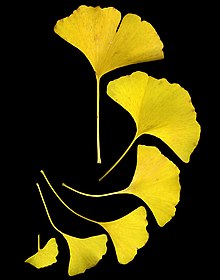
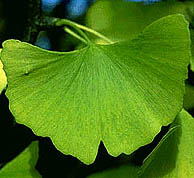
Ginkgos are large trees with somewhat erratic branches and a very long life span. The leaves are very distinctive, being fan-shaped with veins radiating from the base and constantly dividing in two (dichotomous venation).
Gingko Leaves
Taxaceae
| Pacific Yew
|
|
| Info
|
Detailed Information
|
| Family
|
Taxaceae
|
| Species
|
Taxus brevifolia
|
| Identification tips
|
Orange-red fruit with a hard seed inside - 1/4 inches diameter,
|
| Region
|
Northwestern USA and western Canada.
|
Near threatened
|
Introduction to Taxus
The leaves, bark, and seeds of some yews are poisonous, but the fleshy red fruit covering the seed is not. Birds consume and disperse the seeds in dropings.
Taxus brevifolia (Pacific Yew)
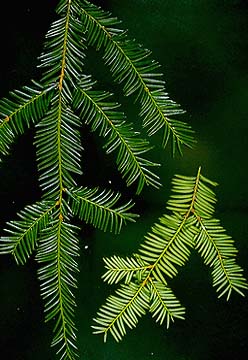
The Pacific Yew is a conifer native to the Pacific Northwest of North America. It is easily distinguished by its modified cones, which resemble bright red berries. These are not berries; they are called arils and are a a modified scale of a seed cone, analogous to the cones of pines. They begin as a green band around the base of the seed and develop into the fleshy red "false-fruit". The leaves are green, flat, and lanceolate. They are arranged spirally on the stem but appear to be in two flat rows due to a twist in the leaf base.
It is also called western yew. Pacific yew tolerates shade, and in undisturbed stands is usually found as an understory tree. Growth of such trees is slow, but where the overstory has been removed or thinned, diameter growth on undamaged yew trees may increase considerably. Pacific yew rarely exceeds 60 cm (24 in) in d.b.h., and 15 m (49 ft) in height. The largest on record is 142 cm (56 in) in d.b.h., and 18 m (60 ft) in height (28). The wood is hard, heavy, and resistant to decay. Although not of great interest to the forest products industry, it has many special uses. The bark of Pacific yew contains a drug, taxol, that is being used in cancer research, so demand for yew bark by the National Cancer Institute has increased dramatically in recent years (9).
Pacific Yew Leaves
Pinaceae
Introduction to Abies
| Balsam Fir
|
|
| Family
|
Pinaceae
|
| Species
|
Abies balsamea
|
| Region
|
Norhteastern USA and eastern Canada.
|
Least concern
|
|
| White Fir
|

|
| Family
|
Pinaceae
|
| Species
|
Abies concolor
|
| Region
|
Western and mountain USA.
|
Least concern
|
|
| Grand Fir
|
|
| Family
|
Pinaceae
|
| Species
|
Abies grandis
|
| Region
|
Northwestern USA and western Canada.
|
Least concern
|
|
| Subalpine Fir
|
|
| Family
|
Pinaceae
|
| Species
|
Abies lasiocarpa
|
| Identification tips
|
Needles are flat in cross section and white-lined on both upper and lower surfaces.
|
| Region
|
Northwestern USA and western Canada.
|
Least concern
|
|
The genus Abies contains the true firs, and includes 48-55 species worldwide and 11 native to North America. Firs are characterized by short, soft, and blunt needles. Cones are upright on the twig and can range from 2 inches to 7 inches in the case of the California Red Fir (A. magnifica). The leaves are curved up on branches with cones; these usually occur high up on the tree. During the fall, cone scales fall off individually, leaving only a central spike. Drops of white resin can often be found on mature cones.
Distinguished by often 2-row or ranked needle arrangement along the twig and flat needles.
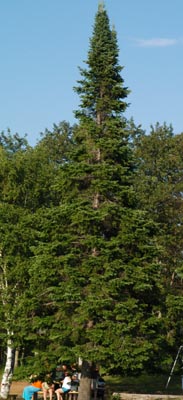
Abies balsamea (Balsam Fir)
The Balsam Fir is a tree native to the Northeast US and much of Northeast and Central Canada.
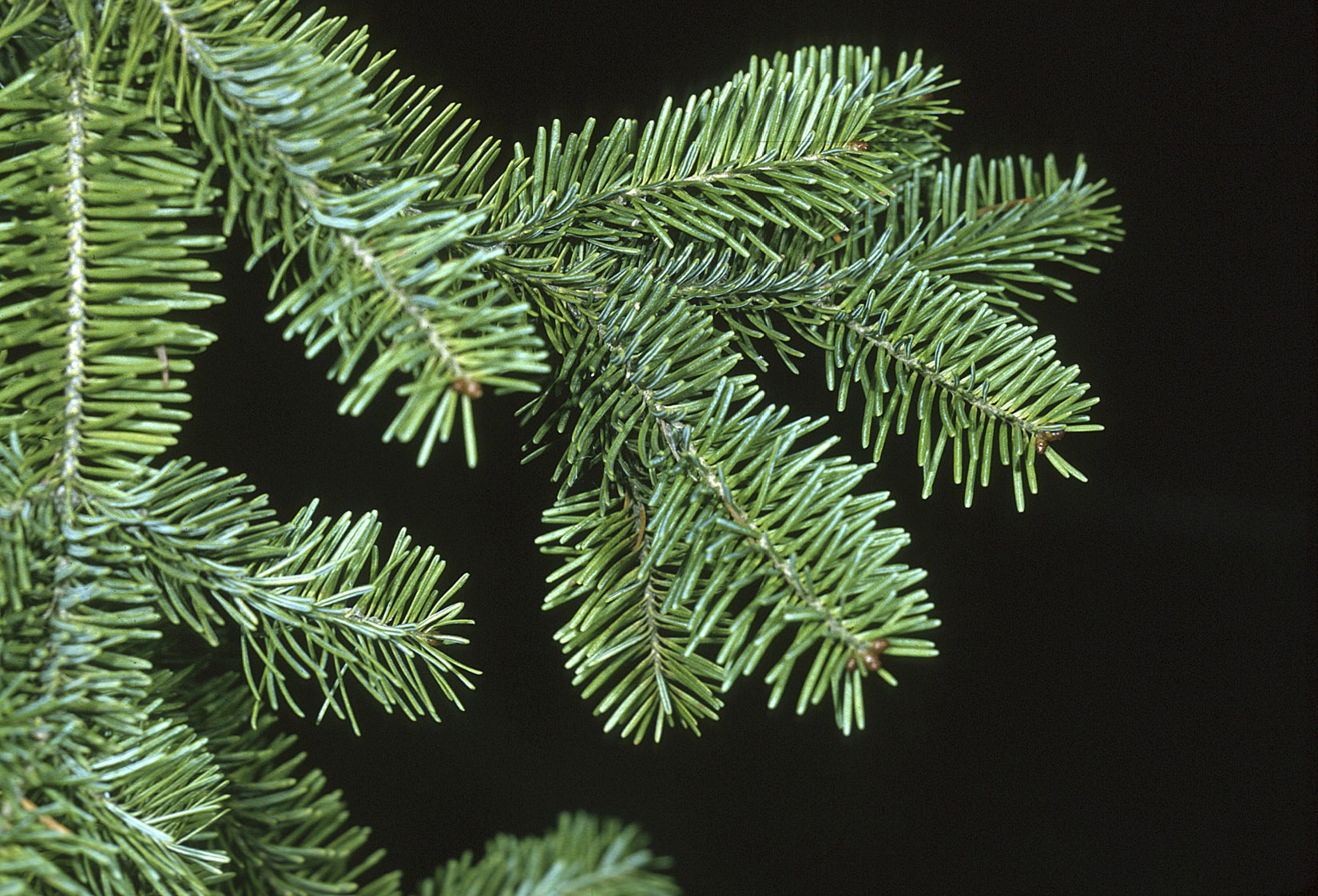
It is a small to medium-size evergreen tree typically 14–20 metres (46–66 ft) tall, rarely to 27 metres (89 ft) tall, with a narrow conic crown. The bark on young trees is smooth, grey, and with resin blisters (which tend to spray when ruptured), becoming rough and fissured or scaly on old trees. The leaves are flat needle-like, 15 to 30 millimetres (½–1 in) long, dark green above often with a small patch of stomata near the tip, and two white stomatal bands below, and a slightly notched tip. They are arranged spirally on the shoot, but with the leaf bases twisted to appear in two more-or-less horizontal rows. The cones are erect, 40 to 80 millimetres (1½–3 in) long, dark purple, ripening brown and disintegrating to release the winged seeds in September.
Balsam Fir Needles
Abies concolor (White Fir)
The White Fir is native to the mountainous regions of the southwest US, and its wood is generally undesirable due to its poor wood quality, softness, and knots. There are two subspecies, and it is closely related to the Grand Fir.
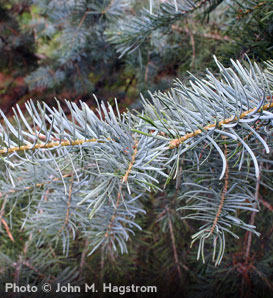
It is a large forest tree from 60 to 200 feet in height that can live up to 300 years or more. Its leaves or needles are 2 to 3 inches long, silvery-blue to silvery-green, extending at nearly right angles
from all sides of the twig; the needles are flattened, stomatiferous above and below, rounded or acute at the apex. The upright cones are 2 to 5 inches long, oblong, olive-green to purple; bracts
shorter than the scales, with short, broad erose shoulders, and spikelike tips. The bark is 4 to 7
inches thick on old trunks, ashy gray and divided by deep irregular furrows in thick, horny flattened
ridges; young stems with conspicuous resin blisters.
White Fir Needles
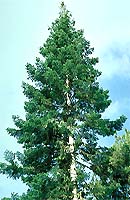
Abies grandis (Grand Fir)
The Grand Fir is native to the northwest regions, mainly in Washington. Often used as an ornamental tree due to its scent, it is used for only cheap constructions. Identifiable by its flat needle growth pattern.
The tree is also used as lumber, pulp, and the leaves and bark were used by Native peoples for dyes, medicines, air fresheners, religious regalia, and basketry. The resin from it's blisters have a variety of uses. (ex. a sealant for wood exposed to water.)
It is a rapid-growing tree that reaches its largest size in the rain forest of the Olympic Peninsula of Washington. One tree in that area measures 200 cm (78.9 in) in d.b.h., 70.4 m (231 ft) tall, and has a crown spread of 14 m (46 ft). The species also has historic significance. The famous Barlow Road snub-trees on the south side of Mount Hood in Oregon were grand firs. They were used by early settlers to control the rate of descent of their covered wagons on a particularly steep slope in their trek from east to west. Some of the rope-burned trees are still standing after 150 years.
Grand Fir Needles
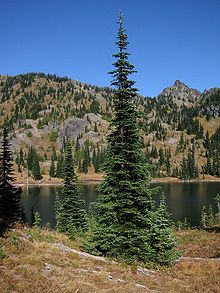
Abies lasiocarpa (Subalpine Fir)
While this tree is restricted to spotty areas of the northwest US, it is heavily prominent in Canada. Grows to a medium size and is used in paper manufacture. This tree has a blue shade, with cone up to 12 cm. The needles are arranged in a vertical, flat pattern, but with twisted petioles. The bark is generally smooth but becomes scaly as the tree matures. While no official subspecies, there are three taxa. The tree shape is tapering, and becomes very thin near the top of the tree, growing many times taller than wide, giving it a slender and spire-like look. The upper several feet of the crown may have a diameter of less than 1 foot. The branches of this tree persist on the trunk right to the ground. This tree seldom exceeds 90 feet in height and 2 feet in diameter at maturity.
The leaves are needle-like, and about 1 inch long. The tips of the leaves are blunt and the leaf itself is flattened and flexible. Even though the leaves arise from twigs on all sides (spirally arranged), they all tend to grow upward. Buds are about ¼ inch long and orange colored.
The twigs are usually smooth with small, inconspicuous leaf scars. Young growth twigs are covered with fine hairs. The bark is thin, smooth, and ash-gray colored on young trees. It becomes somewhat furrowed on older trunks. Small resin blisters are abundant on young to medium age trees. The wood is soft and rather brittle, usually light in color and very quick to decay.
Subalpine Fir
Subalpine Fir Needles and Cones
Introduction to Larix
| Tamarack
|

|
| Family
|
Pinaceae
|
| Species
|
Larix laricina
|
| Identification tips
|
xxx
|
| Region
|
xxx
|
Least concern
|
|
| Western Larch
|

|
| Family
|
Pinaceae
|
| Species
|
Larix occidentalis
|
| Identification tips
|
xxx
|
| Region
|
xxx
|
Least concern
|
|
The larches are ten species of tall slender trees. Larches are the only deciduous members of the pine family, losing their needles each winter. Needles are short and soft, growing singly along new growth, but clustered together, tuft-like on short spur twigs along older growth. Cones are small and held upright along branchlets. They mature in a single growing season and persist several years. Pale green in spring and yellow in fall, larches make attractive landscape trees. Larches are fast-growing, but little-used commercially. With a high resin content, the hard and heavy wood is decay resistant and useful for railroad ties, utility poles, flooring, and cabinetry, but is unsuitable for pulp.
Distinguished by the needles that grow in clusters and radiate from spur twigs.
Larix laricina (Tamarack)
Tamarack, also known as Larch, is one of two conifers on the National List to be deciduous. The needles are characterized as radiating in clusters from the branches. The cones are similar to hemlocks but stand upright.
It commonly grows in swamps and sphagnum bogs but also grows in upland soils. The flaky dark reddish-gray bark of the tamarack tree resembles Black Spruce.It is easily found in boreal forest bogs, ranges from the Canadian Atlantic Provinces and the Northeast to Alaska.
The pale green needles are soft and short (about an inch long) and grow in brush-like tufts on small knobby spurs along each twig. The cones of the tamarack are also fairly small - round, and less than an inch long. Very often you will see the tall tamarack trees growing in pure stands. Just before the needles drop in autumn, the needles turn a beautiful golden color, affording the stands of tamarack a striking contrast to the fall foliage.
Tamarack trees are well adapted to the cold. The tree's natural range is from Labrador to West Virginia, northern Illinois and New Jersey, across southern Canada to Northern British Columbia Alaska. It grows near sea level in northern regions, and at higher elevations in the southern extreme of it’s range.
Tamarack Needles
Larix occidentalis (Western Larch)
The Western Larch is extremely similar to an American Larch, and cones are needed to confidentally tell the two apart. The needles on Western Larch are slightly longer than those of Tamarack, and the cones have bracts projecting.
Introduction to Picea
| Engelmann Spruce
|
|
| Family
|
Pinaceae
|
| Species
|
Picea engelmannii
|
| Identification tips
|
xxx
|
| Region
|
xxx
|
Least concern
|
|
| White Spruce
|

|
| Family
|
Pinaceae
|
| Species
|
Picea glauca
|
| Identification tips
|
xxx
|
| Region
|
xxx
|
Least concern
|
|
| Black Spruce
|

|
| Family
|
Pinaceae
|
| Species
|
Picea mariana
|
| Identification tips
|
xxx
|
| Region
|
xxx
|
Least concern
|
|
| Blue Spruce
|
|
| Family
|
Pinaceae
|
| Species
|
Picea pungens
|
| Identification tips
|
xxx
|
| Region
|
xxx
|
Least concern
|
|
| Red Spruce
|
|
| Family
|
Pinaceae
|
| Species
|
Picea rubens
|
| Identification tips
|
xxx
|
| Region
|
xxx
|
Least concern
|
|
| Sitka Spruce
|

|
| Family
|
Pinaceae
|
| Species
|
Picea sitchensis
|
| Identification tips
|
xxx
|
| Region
|
xxx
|
Least concern
|
|
Spruces differ from all other conifers in having a single, pointed, and usually prickly needles that leave a raised leaf scar on the twig when they fall. Spruce cones hang down from the branches, have relatively thin papery scales, and trees usually have a narrow conical form. Spruce wood is a very important source of lumber for construction and for more specialized uses, such as piano sounding boards, and is used extensively for paper pulp.
Spruce needles are typically not flattened (with the exception of some like the Sitka) and are described as 4-angled (meaning the cross-section of the needles is 4-angled).
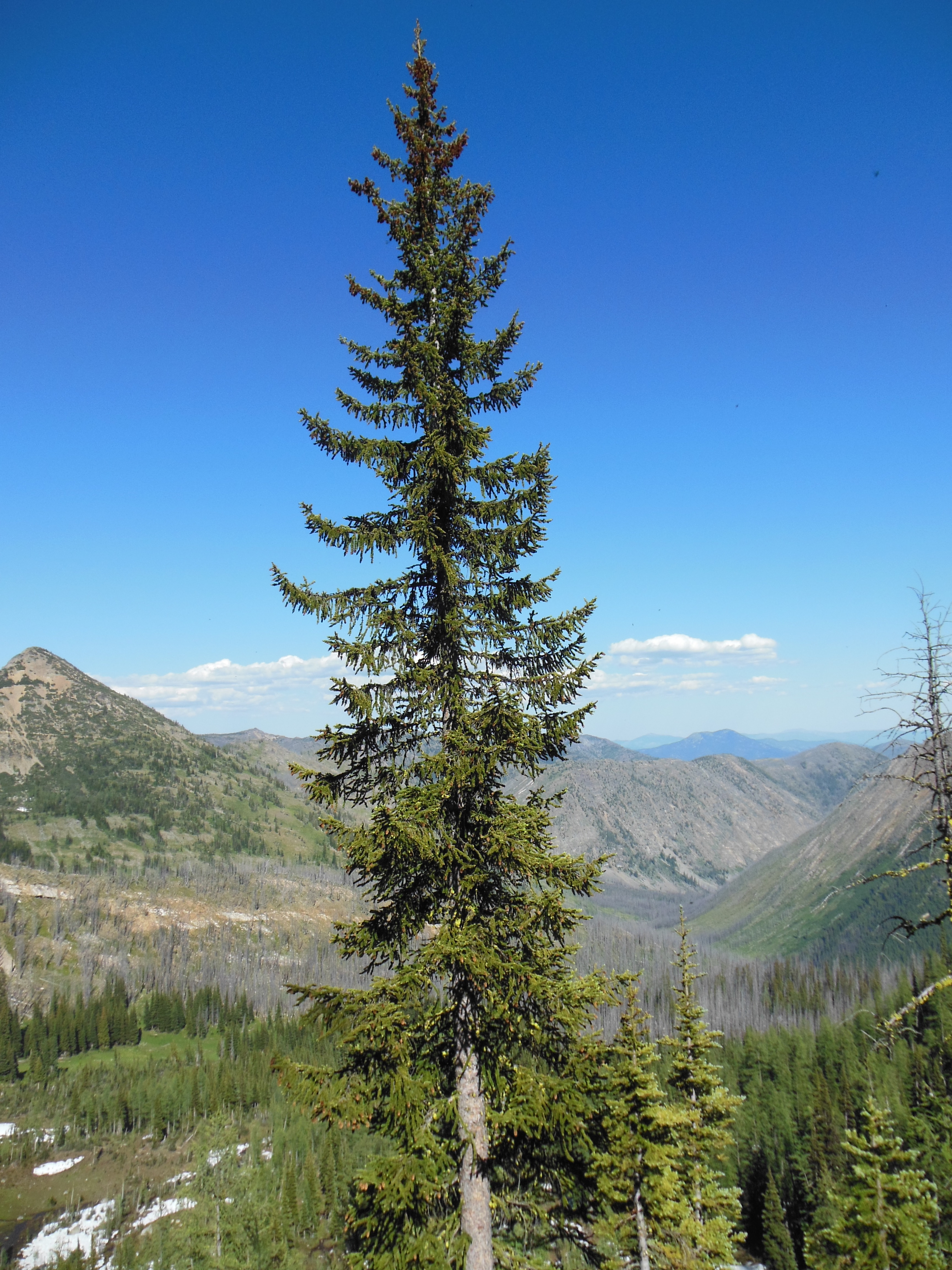
Picea engelmannii (Engelmann Spruce)
Also known as the Engelmann Blue Spruce and Rocky Mountain White Spruce. It is named after the German-American botanist George Engelmann.
It often hybridizes with White Spruce in the North and Blue Spruce in the South.
It can be differentiated from other spruces by its stout twigs and rather large cones with toothed scales. Other resources state that its twigs have fine hairs on it.
Engelmann Spruce is commonly afflicted by the spruce beetle.
Picea glauca (White Spruce)
Also known as the Skunk or Cat Spruce because of its disagreeable odor when its needles are crushed.
Commonly distinguished by hairless, slender twigs and medium sized cones that are broad and flat-tipped.
Picea mariana (Black Spruce)
Also known as Double, Swamp and Gum Spruce. The smallest spruce and often slender with an irregular crown.
It is commonly distinguished by its small 1" cones, very small needles and slender, hairy twigs.
Difficult to distinguish from Red Spruce.
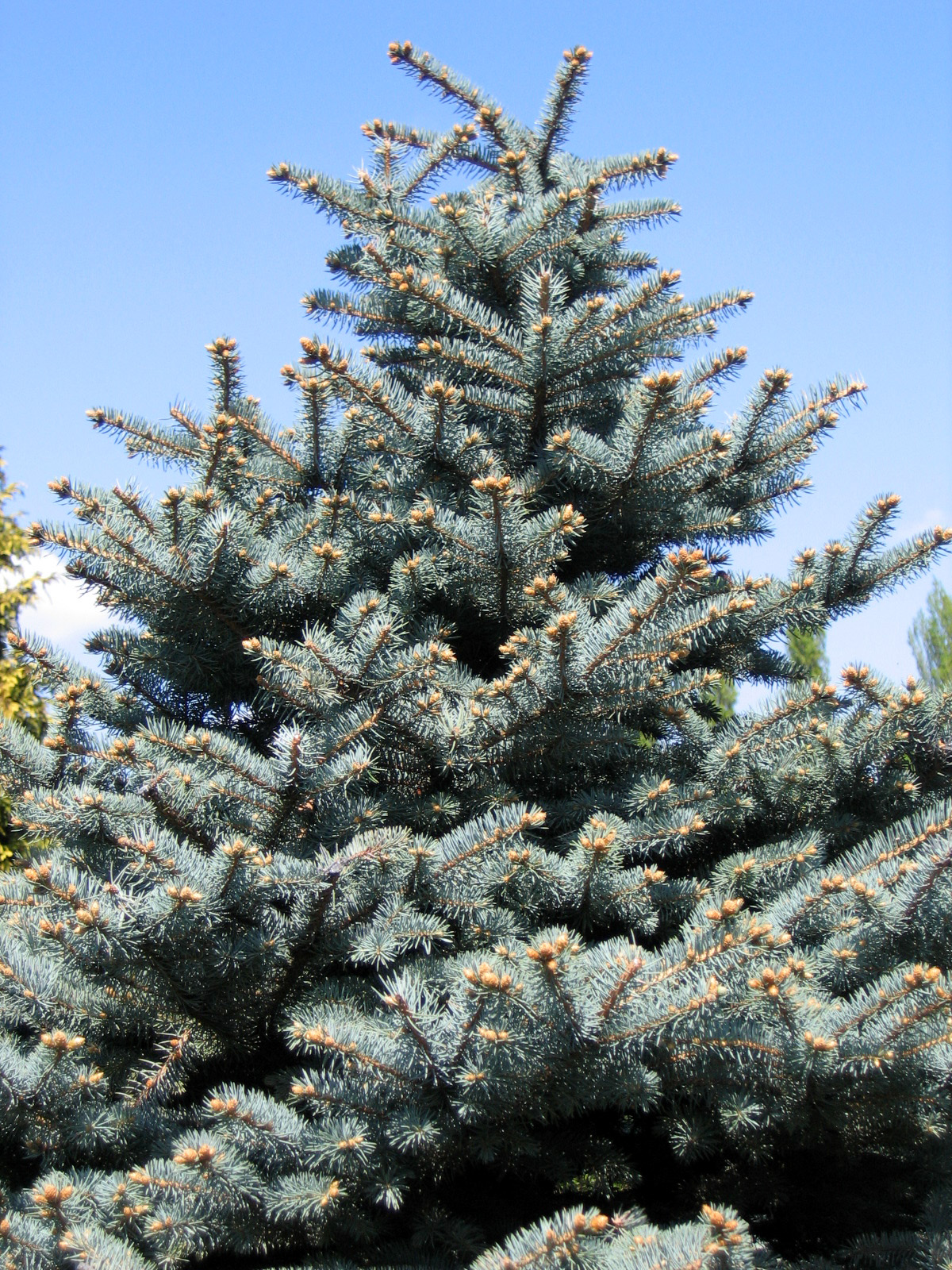
Picea pungens (Blue Spruce)
Also known as the Colorado Spruce.
Most obviously known by its blue foliage.
Distinguished by large narrow-scaled cones, relatively large prickly needles and stout twigs.
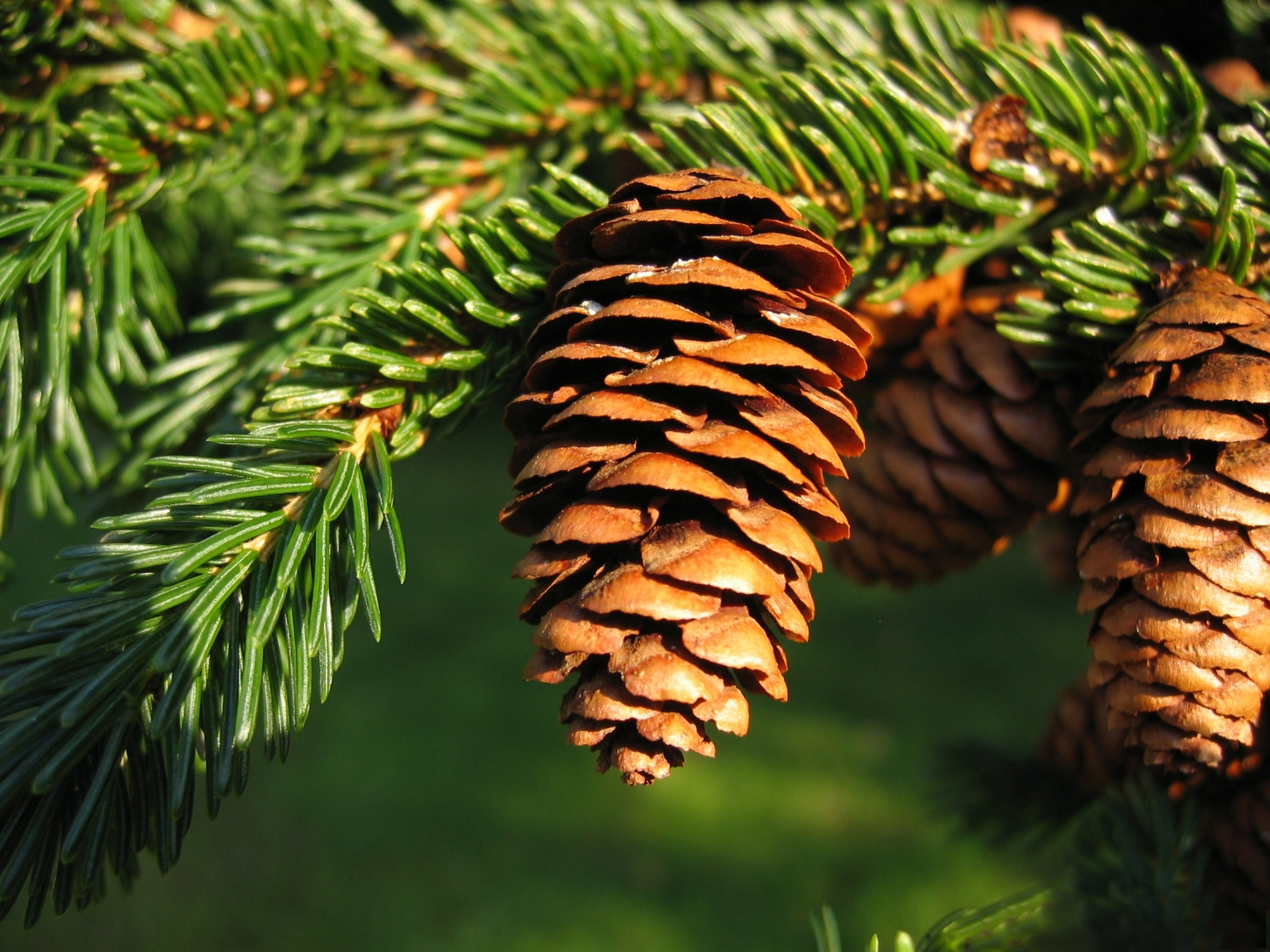
Picea rubens (Red Spruce)
Also known as the Yellow Spruce and He Balsam.
Distinguished by its smaller broad-scaled cones, hairy twigs, short stalk on cones and dense needles.
Slightly larger needles and cones than Black Spruce.
Picea sitchensis (Sitka Spruce)
Also known as Western, Tideland and Alaska Spruce. Very large tree that is important for lumber.
Distinguished by its flattened needles with white bands beneath, large toothed-scaled cones and stout twigs.
Introduction to Pinus
| Knobcone Pine
|

|
| Family
|
Pinaceae
|
| Species
|
Pinus attenuata
|
| Identification tips
|
xxx
|
| Region
|
xxx
|
Least concern
|
|
| Jack Pine
|

|
| Family
|
Pinaceae
|
| Species
|
Pinus banksiana
|
| Identification tips
|
xxx
|
| Region
|
xxx
|
Least concern
|
|
| Lodgepole Pine
|

|
| Family
|
Pinaceae
|
| Species
|
Pinus contorta
|
| Identification tips
|
xxx
|
| Region
|
xxx
|
Least concern
|
|
| Shortleaf Pine
|
|
| Family
|
Pinaceae
|
| Species
|
Pinus echinata
|
| Identification tips
|
xxx
|
| Region
|
xxx
|
Least concern
|
|
| Colorado Pinyon Pine
|
|
| Family
|
Pinaceae
|
| Species
|
Pinus edulis
|
| Identification tips
|
xxx
|
| Region
|
xxx
|
Least concern
|
|
| Sugar Pine
|

|
| Family
|
Pinaceae
|
| Species
|
Pinus lambertiana
|
| Identification tips
|
xxx
|
| Region
|
xxx
|
Least concern
|
|
| Longleaf Pine
|
|
| Family
|
Pinaceae
|
| Species
|
Pinus palustris
|
| Identification tips
|
xxx
|
| Region
|
xxx
|
Endangered
|
|
| Ponderosa Pine
|

|
| Family
|
Pinaceae
|
| Species
|
Pinus ponderosa
|
| Identification tips
|
xxx
|
| Region
|
xxx
|
Least concern
|
|
| Red Pine
|

|
| Family
|
Pinaceae
|
| Species
|
Pinus resinosa
|
| Identification tips
|
xxx
|
| Region
|
xxx
|
Least concern
|
|
| Pitch Pine
|
|
| Family
|
Pinaceae
|
| Species
|
Pinus rigida
|
| Identification tips
|
xxx
|
| Region
|
xxx
|
Least concern
|
|
| Eastern White Pine
|

|
| Family
|
Pinaceae
|
| Species
|
Pinus strobus
|
| Identification tips
|
xxx
|
| Region
|
xxx
|
Least concern
|
|
| Loblolly Pine
|
|
| Family
|
Pinaceae
|
| Species
|
Pinus taeda
|
| Identification tips
|
xxx
|
| Region
|
xxx
|
Least concern
|
|
Pines are distinguished from other genera in the pine family by having relatively long needles in bundles or clusters of two to five and joined at the base, and woody cones with scales thickened at the tip. Needles persist from two to thirty or more years, after which they turn brown and fall in the late summer.
All pines produce cones. Cones of most species mature at the end of their second growing season (some species require three growing seasons to mature). All other trees in the pine family have cones that mature in a single growing season. The familiar pine cone is typically egg-shaped, with many woody scales arranged in a spiral pattern, and each scale protects two seeds. As in other gymnosperms, pines do not have true flowers. Pollen is produced in small male cones appearing at the base of new growth in spring. They may be purple, pink, red, orange, or greenish, but all turn yellow as they release pollen and then pale orange and brown as they dry, falling soon after. Female cones with developing seeds are small and scaly, usually near the tips of new growth in the spring. They are varied colors, as in the male cones, but all become green or purple as the cones grown, and eventually turn brown when fully mature, and grayish several years after maturity. There is variation within each species, but differences in color can still be used for identification, as long as cones of similar age are being compared.
As many other trees, pines produce large crops of fruit at regular intervals, often about every three to seven years. This is thought to be a strategy to reduce seed predation by squirrels, birds, and other animals. When the trees produce a much larger crop of seeds, that supply exceeds the demand, increasing the chances that seeds will be left uneaten and have a chance to germinate. Cones may fall quickly after maturity, or persist for many years. In a few species, cones persist so long that they are enveloped by the growing trunk.
Several species have serotinous cones–they open only when heated by fire. This characteristic is more common in some regions, and varies between individual trees of the same species, so one tree might have its branches festooned with old cones, while a neighboring tree of the same species might have cones that release seeds and fall soon after maturity.
The genus Pinus is separated broadly into the white pine and yellow pine group, differing in many ways. In economic value, pines rank among the most important groups of trees,. They are harvested from the wild and grown commercially worldwide for lumber and for pulp. Pine sap also provides turpentine, and was formerly an important source of pitch and resin, but similar products are now derived from petroleum. Pines are a dominant plant in a variety of ecosystems across north america, and many other species of plants and animals depend on pines for food and shelter.
White Pine Group- Usually in bundles of 5, slender and flexible. Twigs smooth after needles fall. Cones narrow with thin scales and no prickles. Stalked. Thin and scaly bark.
Yellow Pine Group- Usually in bundles of 2 or 3, thicker and stiffer. Twigs rough after needles fall. Cones broader with thick scales and prickles. Not stalked. Broad plates on bark.
Pinus attenuata (Knobcone Pine)
Also known as Pinus tuberculata, this tree ranges from southern Oregon to Baja California, though it is mostly concentrated at the two states' border. It grows in mild climates and poor soil.
Growing to 25-80 feet, it features needles in bundles of 3, with 6-9 whorled around the branch. It's cone is serotinus, sometimes even embedding it self in the tree.
Pinus banksiana (Jack Pine)
Jack Pines are native to the boreal forests of eastern and central Canada, as well as New England and the Midwest south to Missouri. It is identified by its 2 needles, which are divergent, very short and sometimes have a "wishbone" character, as well as its diminutive cones, which are usually about 2 inches.
This species has adapted to fires, which are required to open up the small cones.
In Michigan, this species is closely tied to the endangered Kirtland's Warbler, which only nest in mid-sized jack pines. Due to this habitat's scarcity in Michigan, this species only numbers about a few thousand in the wild, though efforts to properly time forest fires in key areas has resulted in an increase in population.
Pinus contorta (Lodgepole Pine)
Lodgepole Pines are found in much of the Pacific Northwest, extending south to Southern California. It commonly hybridizes with jack pine in narrow range of overlap. Like Jack Pine, it is also a fire dependent species. The tallest individual is found near Big Bear in the San Bernardino mountains of Southern California. Unlike Jack Pine, this species has a regular habit, and tends to grow straight up, with regularly spaced branches of gradually decreasing length.
This species is identified by the cones, which are larger than Jack Pine cones, and have prickles, as well as the needles, which are longer and have less of a divergent character.
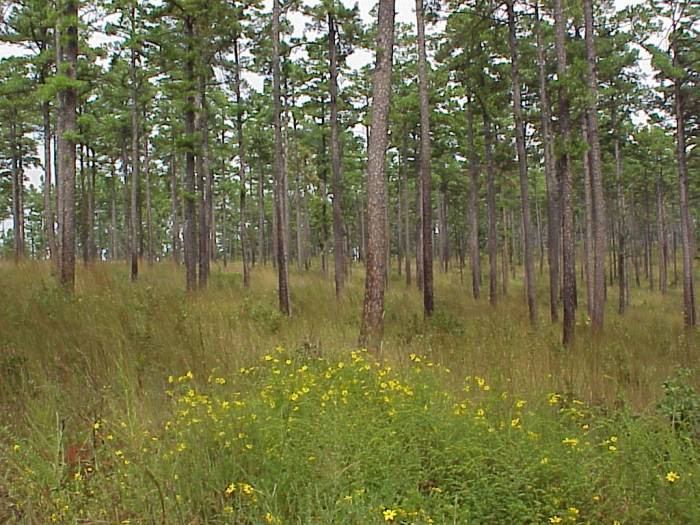
Pinus echinata (Shortleaf Pine)
The Shortleaf Pine is an evergreen tree native to eastern US from southern New York to northern Florida, west to the extreme southeast of Kansas, and southwest to eastern Texas. Its uses include wood pulp, plywood veneer, and lumber. The endangered red-cockaded woodpecker lives in old-growth shortleaf pine with decayed heartwood, but such trees are dying primarily by the Southern Pine Beetle. Littleleaf disease is the most serious disease affecting Shortleaf Pine.
It is a medium to large tree reaching heights of 20-30 meters. Its needles are 3-5 inches long, with 2-3 on the same branch. They are dark yellow-green. The flowers are monoecious. The males are cylindrical, red to yellow, and in clumps at the ends of twigs. The females are light green to red. The fruit is 2 inch long egg-shaped cone. The bark is scaly, thin, and dark when young and turns red-brown. There may be very small resin pockets.
Pinus edulis (Colorado Pinyon Pine)
The piñon pine (Pinus edulis) is a small to medium size tree, reaching 10–20 metres (33–66 ft) tall and with a trunk diameter of up to 80 centimetres (31 in), rarely more. The bark is irregularly furrowed and scaly. The leaves ('needles') are in pairs, moderately stout, 3–5.5 cm (1.2–2.2 in) long, and green, with stomata on both inner and outer surfaces but distinctly more on the inner surface forming a whitish band.
The range is in Colorado, southern Wyoming, eastern and central Utah, northern Arizona, New Mexico, and the Guadalupe Mountains in westernmost Texas.
Pinus lambertiana (Sugar Pine)
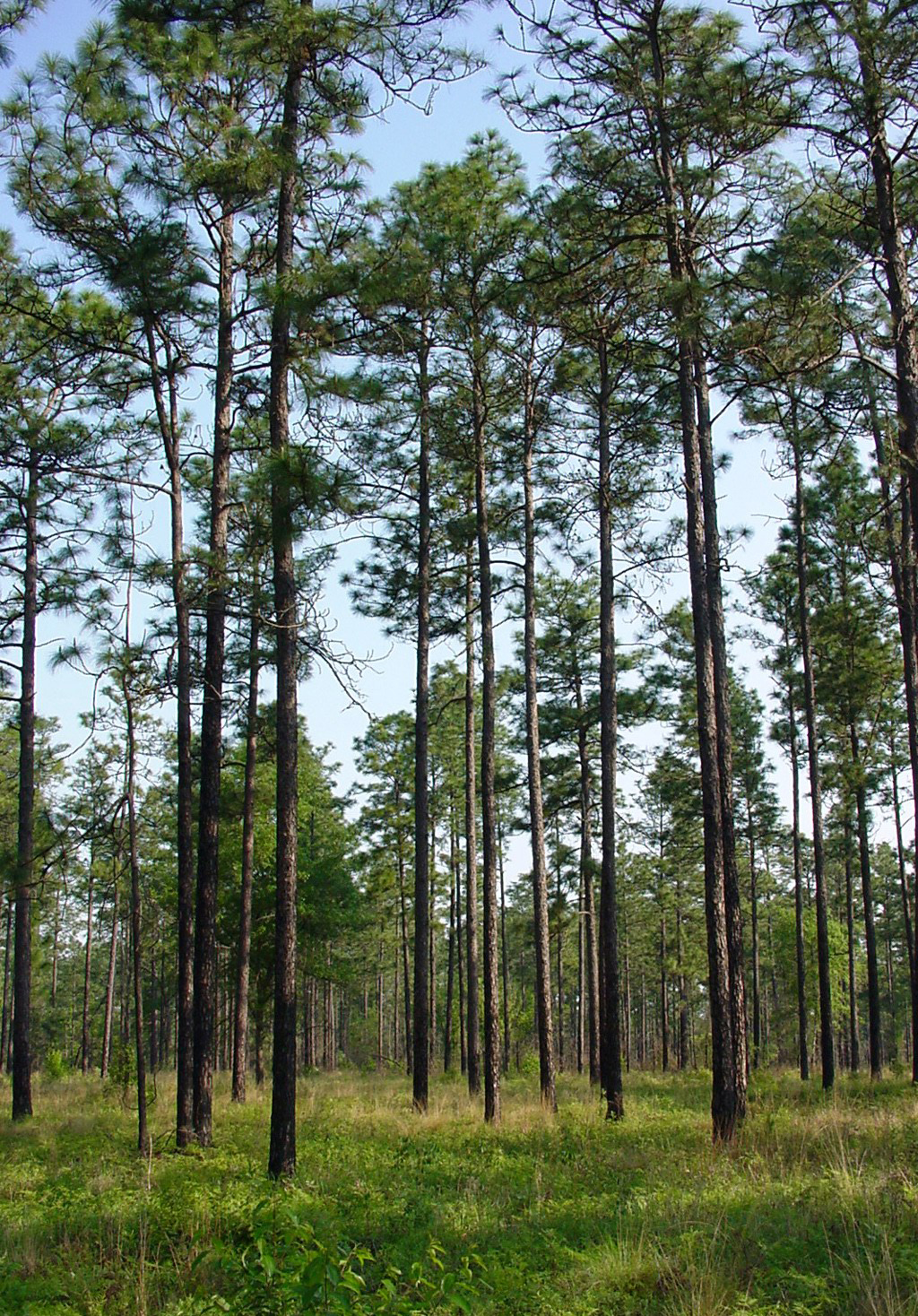
Pinus palustris (Longleaf Pine)
Pinus ponderosa (Ponderosa Pine)
Pinus resinosa (Red Pine)
Pinus rigida (Pitch Pine)
Pinus strobus (Eastern White Pine)
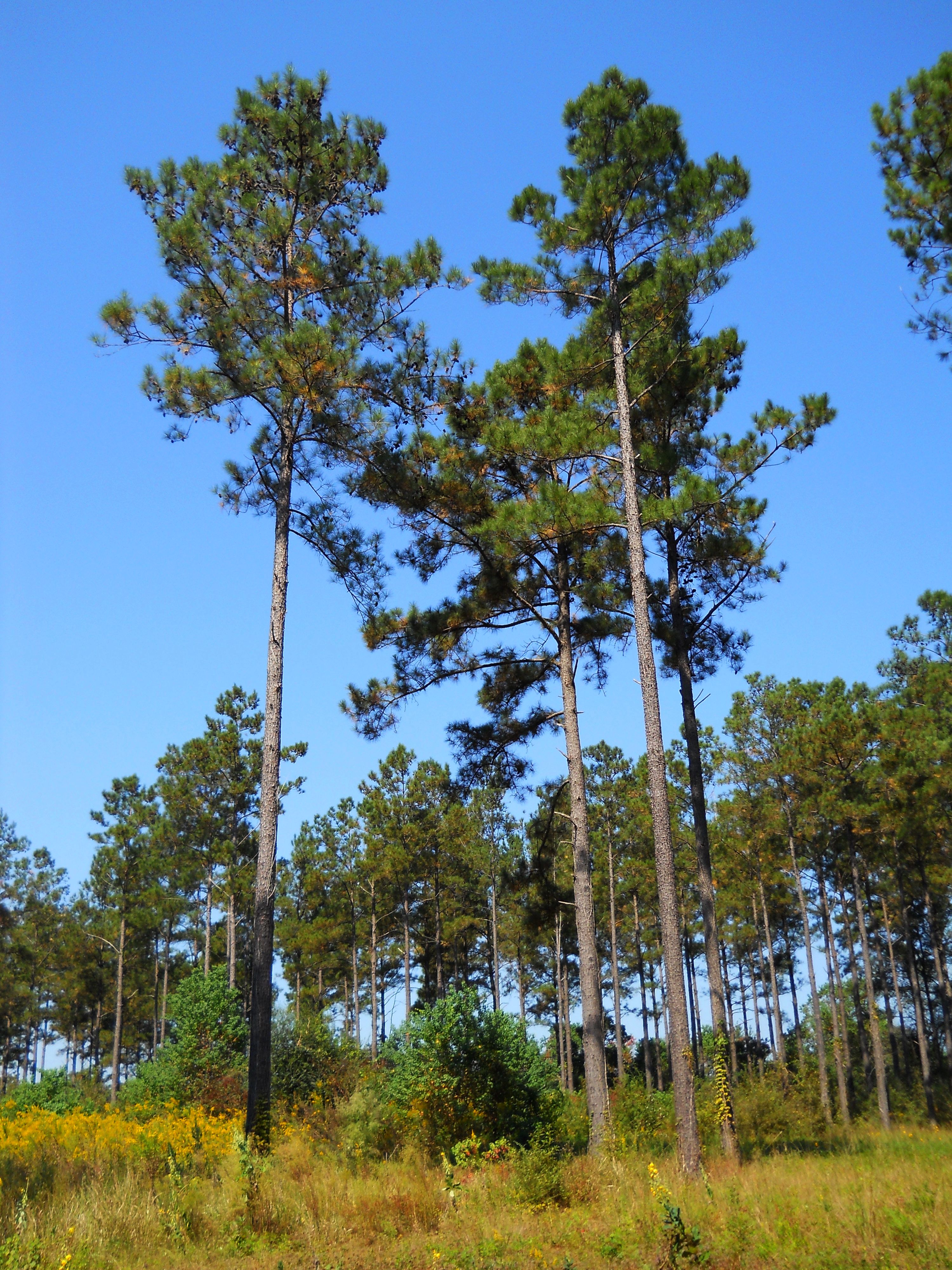
Pinus taeda (Loblolly Pine)
Introduction to Pseudotsuga
| Douglas fir
|

|
| Family
|
Pinaceae
|
| Species
|
Pseudotsuga menziesii
|
| Identification tips
|
xxx
|
| Region
|
xxx
|
Least concern
|
|
Pseudotsuga menziesii (Douglas Fir)
The Douglas fir is a large tree, the tallest in the Pinaceae family. They are 20-100 metres tall, and often reach a diameter of up to 8 feet, though trees can reach diameters of up to 16 feet. The largest coast Douglas-firs regularly live over 500 years, and the oldest can live for over 1,300 years, though Rocky Mountain Douglas-firs do not usually exceed 400 years. It is also known as Douglas-fir, Douglas spruce, Oregon pine, and Columbian pine, though it is not a true fir, spruce, or pine. The genus name Pseudotuga means "false hemlock".
Introduction to Tsuga
| Eastern Hemlock
|

|
| Family
|
Pinaceae
|
| Species
|
Tsuga canadensis
|
| Identification tips
|
xxx
|
| Region
|
xxx
|
Near threatened
|
|
| Western Hemlock
|

|
| Family
|
Pinaceae
|
| Species
|
Tsuga heterophylla
|
| Identification tips
|
xxx
|
| Region
|
xxx
|
Least concern
|
|
| Mountain Hemlock
|

|
| Family
|
Pinaceae
|
| Species
|
Tsuga mertensiana
|
| Identification tips
|
xxx
|
| Region
|
xxx
|
Least concern
|
|
Tsuga canadensis (Eastern Hemlock)
Tsuga heterophylla (Western Hemlock)
Tsuga mertensiana (Mountain Hemlock)
Cupressaceae
Cupressaceae is the conifer & cypress family; they are found worldwide (130-140 total species). This family has 4 genera that are native to North America, although they could be used interchangeably with the family Taxodiaceae. Mature trees have a bark that ranges from orange to red to brown in color, with a stringy texture that is often seen flaking & peeling into vertical, scaly, or cracked strips. Leaves are arranged spirally, crossing in pairs, or crossing whorls of 3-4. Earlier on, leaves are needlelike (if they keep them when they mature depends on genus). The seed cones vary from woody, to leathery, to berrylike, ranging from 10-25 mm in length; cone scales are arranged spirally, opposite, or whorled. Seeds are mildly flattened with two wings either side of the seed, with 2-6 cotyledons. Pollen cones are 1-20 mm long, arranged exactly like cone scales, varying in distribution depending on genus.
Introduction to Chamaecyparis
| Port Orford Cedar/Lawson Cypress
|
|
| Family
|
Cupressaceae
|
| Species
|
Chamaecyparis lawsoniana
|
| Identification tips
|
xxx
|
| Region
|
xxx
|
Near threatened
|
|
Chamaecyparis, commonly known as false cypress or cypress, are a genus of conifers native to East Asia and the coasts of the US; of these two species are native to the US. They range from medium to large, reaching heights of 20-70 m (66-230 ft). The foliage grows in flat sprays, with two types of leaves: needlelike leaves when the trees are young, and scale leaves when the trees reach maturity. Cones are spherical or oval, with 8-14 scales arranged in opposite crossing pairs, with each scale containing 2-4 seeds.
Chamaecyparis lawsoniana (Port Orford Cedar/Lawson Cypress)
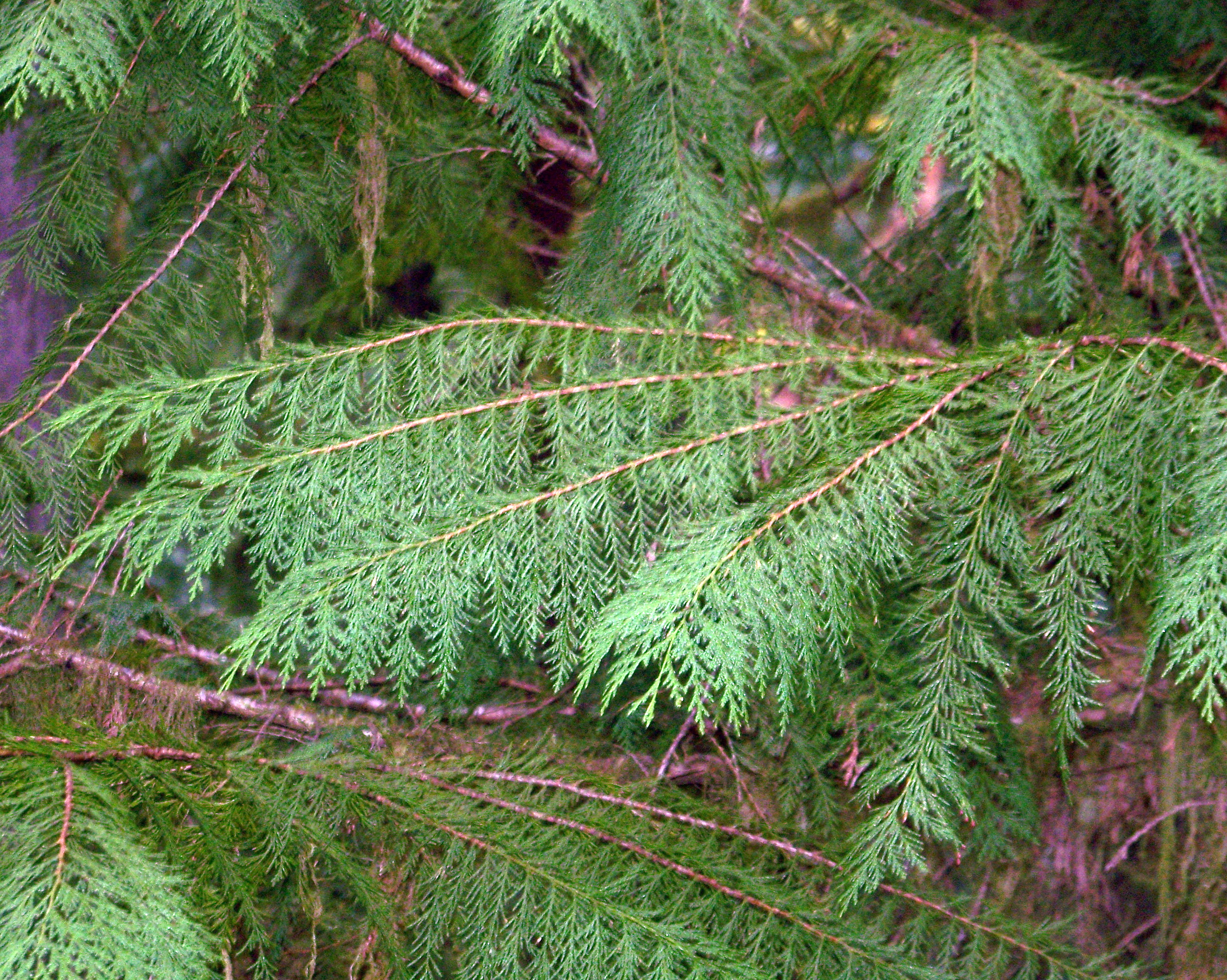
The Lawson Cypress is a conifer in the Chamaecyparis genus, native from Oregon to northwest California, often growing in mountain valleys of the Klamath Mountains along streams, growing at a height from sea level to 1500 m (4900 ft). They grow to 197 m (60) and more, with trunks 1.2-2 m (4-7 ft) in diameter. Leaves are feathery and pungent, growing in sprays that is gray-blue gray in color with a white underside, scale in shape with the length of 3-5 mm (⅛-3/16 in) in length. The seed cones are spherical, 7-14 mm (9/32-9/16 in) in diameter, with 6-10 scales that mature brown 6-8 months after pollination; male cones are 3-4 mm (⅛-5/32 in) long, turning brown in early spring after pollen release. The bark is made up of reddish-brown fibrous vertical strips. They live in well-drained, moist soils, in a sheltered position with full sun.
Introduction to Cupressus
| Montery Cypress
|

|
| Family
|
Cupressaceae
|
| Species
|
Cupressus macrocarpa
|
| Identification tips
|
xxx
|
| Region
|
xxx
|
Vulnerable
|
|
Cupressus is a genus of evergreen conifers in the family Cupressaceae. There are 17 trees native to North America in this genus, of the New World variety, which have fewer, more narrow pointed seed scales. Trees/bushes in this genus grow to be 5-40 m tall. The leaves, like those of others in this family, are scalelike, arranged in opposite crossing pairs, usually of length 2-6 mm. When plants are >2 years of age, the leaves are needlelike & of length 5-15 mm. The seed cones are 8-40 mm long, round-ovular, with seeds 4-7 mm long, 4-14 scales arranged in opposite crossed pairs; they mature 18-24 months after pollination. Trees are relatively adapted to forest fires, with seed cones surviving with seeds intact even after parent trees are killed in a fire.
Cupressus macrocarpa (Monterey Cypress)
The Monterey Cypress is one of the cypresses endemic to California, found naturally in the Central Coast of California; it is a coniferous evergreen tree. The two native forests (Point Lobos State Reserve and Del Monte Forest) this cypress is from are protected, living in an environment constantly bathed in sea fog and with cool, moist summers. It often becomes flat-topped due to the winds frequently blowing in native areas, growing to heights of 40 m (133 ft) and a diameter of 2.5 m (+8 ft). The leaves are scalelike and 2-5 mm long, growing in dense sprays bright green in color. Seed cones are round to oblong, 20-24 mm long with 6-14 scales, maturing from green to brown 20-24 months after pollination. Pollen cones are 3-5 mm long, releasing pollen in late winter-early spring.
Introduction to Juniperus
| Utah Juniper
|
|
| Family
|
Cupressaceae
|
| Species
|
Juniperus osteosperma
|
| Identification tips
|
xxx
|
| Region
|
xxx
|
Least concern
|
|
| Rocky Mountain Juniper
|

|
| Family
|
Cupressaceae
|
| Species
|
Juniperus scopulorum
|
| Identification tips
|
xxx
|
| Region
|
xxx
|
Least concern
|
|
Junipers are a genus of (taxonomically speaking) 50-67 species distributed worldwide, with 2 listed on the 2013 tree list. The heights vary from 65-130 ft (20-40 m) with low spreading shrubs and long, trailing branches. The leaves are scalelike and needlelike in dark-gray-blue green and reddish-brown colors. The female seed cones have an aroma used in cooking and fleshy scales forming a structure resembling a “berry” that are 4-25 mm (0.16-1 in) long, with 1-12 unwinged seeds; the colors in these seed cones range from red-brown to orange but mostly blue. Male cones have 6-20 scales, shedding most of their pollen early spring and some pollinating in the fall.
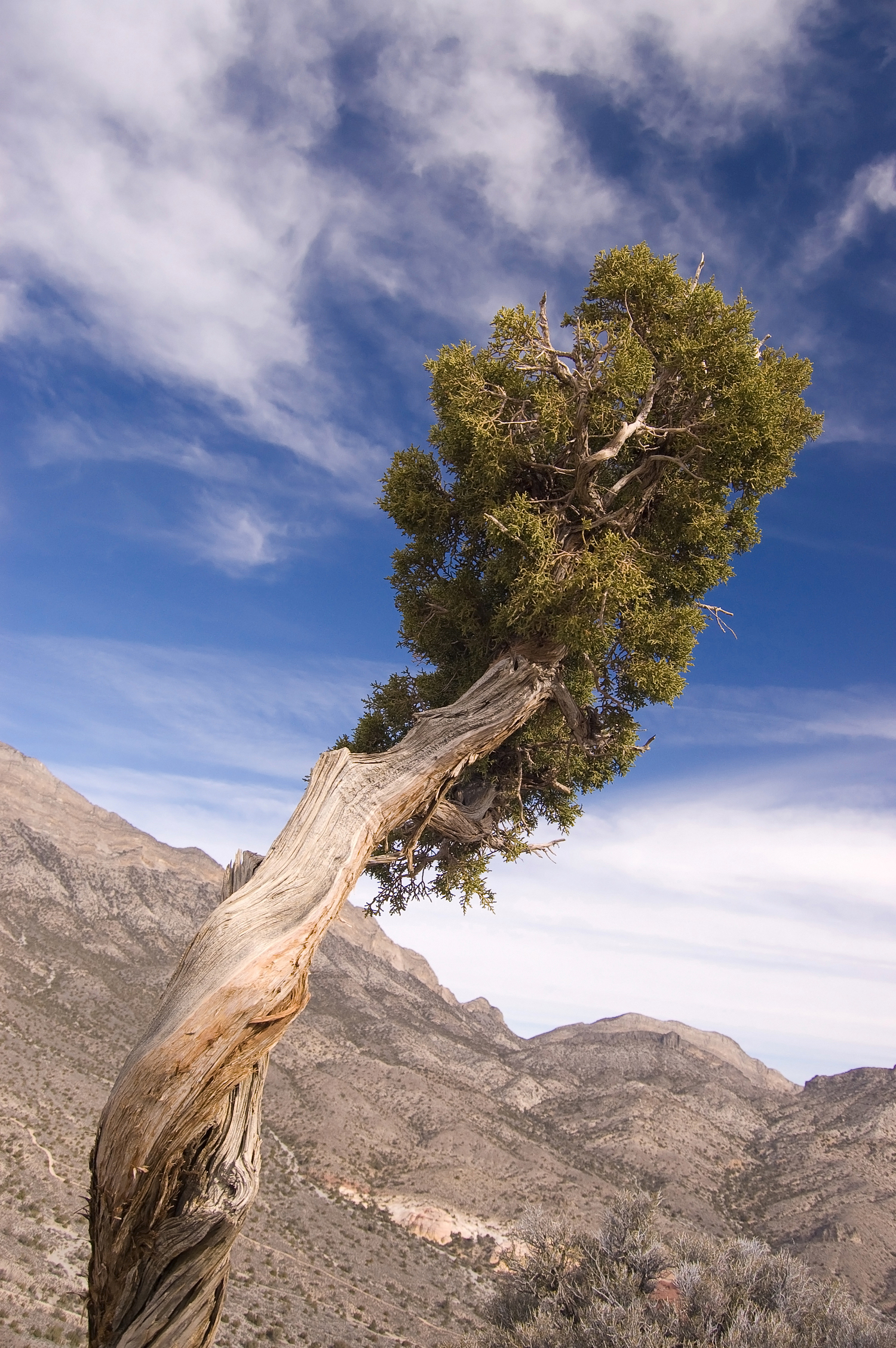
Juniperus osteosperma (Utah Juniper)
Utah Juniper is a shrub/small tree that grows mostly from 3-6 m (10-20 ft), sometimes 9 m (~30 ft) tall, native to Utah, Nevada, Arizona, Wyoming, western Colorado and New Mexico, southern Montana and Idaho, and eastern California. It grows at altitudes of 1,300–2,600 m (4,300–8,500 ft) in dry soil. The shoots are 1.5-2 mm in diameter. Leaves are in opposite whorls of three that cross at a “X”, scalelike and 1-2 mm (5 mm on lead shoots) long, in a yellowish-green to green color. The cones are berrylike, 8–13 mm (0.31–0.51 in) in diameter, blue-brown with a whitish waxy bloom, and contain a single seed (rarely two). The cones mature in 18 months. The male cones are 2–4 mm (0.079–0.157 in) long, and shed their pollen in early spring. It is of Least Concern, with an IUCN of 3.1.
Juniperus scopulorum (Rocky Mountain Juniper)
This juniper is native to British Columbia, southwest Alberta, Washington-North Dakota-Arizona-Texas, and northernmost Mexico from Sonora to Coahuila, growing in altitudes of 500–2,700 m (1,600–8,900 ft) in dry soils. It grows to a height of 5-15 m (16-49 ft), sometimes 20 m (66 ft), with a diameter of 1 m (3 ft) and occasionally 2 m (7 ft). The leaves are arranged in whorls of 3 that cross oppositely in a “X”. Young leaves are needlelike, 5–10 mm long; adult leaves are scalelike, 1–3 mm long (to 5 mm on lead shoots) and 1–1.5 mm (0.039–0.059 in) broad. The seed cones are berrylike, round to double lobed, 6–9 mm (0.24–0.35 in) in diameter, dark blue with a pale blue-white bloom. Seed cones contain two seeds (occasionally one or three), maturing in ~18 months. The pollen cones are 2–4 mm (0.079–0.157 in) long, and shed pollen in early spring.
Introduction to Sequoia
| California Redwood
|
| Family
|
Cupressaceae
|
| Species
|
Sequoia sempervirens
|
| Identification tips
|
xxx
|
| Region
|
xxx
|
Endangered
|
|
Sequoia is a genus of conifer(s) in the taxodiaceae family (named after the Cherokee leader Sequoyah), with only one remaining species left, as the rest of the species are now fossils. The fossil remains of the plants in this genus can be found as far back as from the Jurassic Period (~200-145.5 million years ago) dispersed across the Northern Hemisphere. The remaining species in this genus can be found in the fog belt from southern Monterey county to southern Oregon
Sequoia sempervirens (California Redwood)
Also called coast redwood or coastal redwood, this evergreen is one of the longest-living trees, living for 1200-2000 years or more. One of the tallest trees on Earth, they reach heights of 115.5 meters (379 feet) in height (not counting roots) and a diameter of 8.9 meters (29.2 feet) in dbh (diameter at breast height) (diameter at trunk height is 9 meters or 30 feet). They are native and used to grow in heavy forests from the coast of California (excluding socal) to southern Oregon. The bark is incredibly thick with widths reaching up to 30 centimeters (1 foot), soft, and fibrous; the bark (when freshly exposed) is of a red color, hence giving it the name “redwood”. The leaves have the shape of scales, arranged in a spiral shape; the lengths can vary from 15-25 mm (⅝-1 in) long on young trees to 5-10 mm (¼-⅜ in) long on the upper crown of older trees. The branches of the tree are slightly drooping and the shape of the branches is that of a conical crown. Cones of the tree are ovular in shape, 15-32 mm (9/16-1 ¼ in) long, with 15-25 scales; each cone bears 3-7 seeds each 3-4 mm (⅛-3/16 in) and 0.5 mm (0.02 in) broad, with two wings 1 mm (0.04 in) wide.
Redwood trees live in damp and moist environments that receive up to 2500 mm (100 in) of rain annually; cool air from the coast & fog keep the environment moist. The soil they grow in lacks a lot of nutrients, so redwoods are reliant on the organisms around them to keep cycling the nutrients from dead redwoods back and forth. Redwoods live in flood-prone environments, thus, after a flood, they grow their roots into the recently deposited layers of sediment; a second root system develops from adventitious buds on the newly buried trunk ==== Pinus palustris (Longleaf Pine) ====
and the old root system dies. They are resistant to insect attack, fungal infection, and rot due to the terpenoids & tannic acids in their roots, bark, wood, and leaves, preventing them from deadly insect infections.
Redwood has been heavily logged as they are valued for its ability to absorb water, resist fire & decay, beauty, and light weight. 3,640 square kilometers (899,000 acres) of redwood trees have been logged in California; the wood was used to build railroad ties & trestles, which was then recycled to build borders, steps, house beams, etc.
Introduction to Sequoiadendron
| Giant Sequoia
|
| Family
|
Cupressaceae
|
| Species
|
Sequoiadendron giganteum
|
| Identification tips
|
xxx
|
| Region
|
xxx
|
Vulnerable
|
|
Sequoiadendron is a genus of two evergreen coniferous trees, with one of which still lives to this day. Fossilized remains of sequoiadendron can be found dating as far back to the Cretaceous period throughout the Northern Hemisphere in places like west Georgia (the country) & the Caucasus region.
Sequoiadendron giganteum (Giant Sequoia)
Giant sequoia is the only surviving tree in the genus sequoiadendron; as the name suggests, they are quite massive, growing to an average height of 50-85 meters (164-279 feet), with drunk diameters ranging from 6-8 meters (20-26 feet). The specimen with the greatest dbh is the General Grant tree at 8.8 meters (29.8 feet); the oldest known giant sequoia is believed to be 3200-3266 years old; giant sequoias are one of the oldest living organisms on Earth. The bark is fibrous (much like that of a redwood), furrowed, with the estimated thickness of ~90 cm (~3 feet) at the trunk. The leaves are awl-shaped, 3-6 mm (⅛-¼ in) long, arranged in a spiral formation at each shoot. Their sap, containing tannic acid, protects the tree from major fire damage. Seed cones 4-7 cm (1 ½-3 in) long, which take 18-20 months to mature (some may take even 20 years), with 30-50 cone scales and 230 seeds per cone; a large tree can have 11000 cones or more. Water from the roots can be pushed up to extreme heights due to negative pressure.
They are found naturally only in groves in the western portion of the Sierra Nevada mountain range in California. Listed as an endangered species by the IUCN, there are less than 80000 trees remaining; an estimated 10-14% of the remaining trees were destroyed from the Castle Fire of 2020. Sequoias are highly adapted to normal forest fires, as their bark is fire-resistant and seed cones open immediately after a fire; seeds can only grow successfully in mineral rich soil & full sun. Fires bring hot air high into the canopy, thus opening the cones, scattering the seeds which falls into the seedbed with favorable conditions as the loose ground ash protects the seeds from ultraviolet radiation. Fire suppression efforts & livestock grazing has not allowed low-intensity forest fires to naturally occur in these groves, which leads to ground fuel buildup thus causing high-intensity fires that threaten giant sequoias. Climate change is also playing a role in increasing the intensity and frequency of forest fires within the Giant Sequoia's range.
Giant sequoia wood is damage resistant but highly brittle, thus not making it ideal for construction; loggers have logged the groves from the 1880s-1920s. The wood is used to build shingles, fence posts, and even matchsticks. Young plantation-grown trees are not brittle, thus making them similar to redwood and making young sequoia a likely high-yielding timber crop. Some giant sequoias are grown as Christmas trees but the main economic uses for giant redwood is tourism & horticulture.
Introduction to Taxodium
| Bald cypress
|
| Family
|
Cupressaceae
|
| Species
|
Taxodium distichum
|
| Identification tips
|
xxx
|
| Region
|
xxx
|
Least concern
|
|
| Pond cypress
|
| Family
|
Cupressaceae
|
| Species
|
Taxodium distichum v. nutans//Taxodium distichum v. Taxodium ascendens
|
| Identification tips
|
xxx
|
| Region
|
xxx
|
Least concern
|
|
Taxodium is a genus of flood-tolerant conifers in the cypress family Cupressaceae. They are found in southern North America; they are deciduous north and semi evergreen-evergreen (not coniferous) in the south. There are only 2 species in this genus, with only one being on the 2024 National Tree List.
Taxodium distichum (Baldcypress)
Baldcypress is native to the swampy habitats of the Southeastern United States. Baldcypress is large, with many specimens growing between 25 and 40 meters during their lifetime. The tree can be identified by its large cones which look a bit like brains, and its needles look like that of the Eastern Redcedar, but longer. Baldcypress is used in the building industry due to its ability to resist rot and strength against water. Baldcypress are a major nesting site for Bald Eagles, making them an object of conservation interest. It is the state tree of Louisiana.
Taxodium distichum v. nutans//Taxodium distichum v. Taxodium ascendens (Pondcypress)
Pond cypress, although incredibly similar to baldcypress, differs in habitat; they live in wetlands such as shallow ponds, lake margins, blackwater rivers, and swamps. They are native from southeastern Virginia to southeastern Louisiana to Florida. They are a deciduous conifer, growing 15-18 meters (49-59 feet) in height, preferring acidic, poorly drained, wet soils. Their leaves are shorter than the ones of baldcypress (3 mm-10 mm), slender, on shoots that are usually erect. The expanded base trunk is used to anchor the tree in its environment of wet, muddy soil, with a bark the color of pale gray, and with cones no bigger than 2.5 cm in diameter. Like baldcypress, they have these roots above the ground called “cypress knees”.
Introduction to Thuja
| Northern White-Cedar
|
| Family
|
Cupressaceae
|
| Species
|
Thuja occidentalis
|
| Identification tips
|
xxx
|
| Region
|
xxx
|
Least concern
|
|
| Western Redcedar
|
| Family
|
Cupressaceae
|
| Species
|
Thuja plicata
|
| Identification tips
|
xxx
|
| Region
|
xxx
|
Least concern
|
|
Thuja occidentalis (Northern White-Cedar)
Thuja plicata (Western Redcedar)
Palmae/Arecaceae
Introduction to Sabal
| Cabbage Palmetto
|
| Family
|
Palmae/Arecaceae
|
| Species
|
Sabal palmetto
|
| Identification tips
|
xxx
|
| Region
|
xxx
|
Least concern
|
|
Sabal palmetto (Cabbage Palmetto)
Introduction to Washingtonia
| California Fan Palm
|
| Family
|
Palmae/Arecaceae
|
| Species
|
Washingtonia filifera
|
| Identification tips
|
xxx
|
| Region
|
xxx
|
Least concern
|
|
Washingtonia filifera (California Fan Palm)
Salicaceae
Introduction to Populus
| White Poplar
|
| Family
|
Salicaceae
|
| Species
|
Populus alba
|
| Identification tips
|
xxx
|
| Region
|
xxx
|
Least concern
|
|
| Narrowleaf Cottonwood
|
| Family
|
Salicaceae
|
| Species
|
Populus angustifolia
|
| Identification tips
|
xxx
|
| Region
|
xxx
|
|
|
|
| Balsam Poplar
|
| Family
|
Salicaceae
|
| Species
|
Populus balsamifera
|
| Identification tips
|
xxx
|
| Region
|
xxx
|
Least concern
|
|
| Eastern Cottonwood
|
| Family
|
Salicaceae
|
| Species
|
Populus deltoides
|
| Identification tips
|
xxx
|
| Region
|
xxx
|
Least concern
|
|
| Bigtooth Aspen
|
| Family
|
Salicaceae
|
| Species
|
Populus grandidentata
|
| Identification tips
|
xxx
|
| Region
|
xxx
|
Least concern
|
|
| Quaking Aspen
|
| Family
|
Salicaceae
|
| Species
|
Populus tremuloides
|
| Identification tips
|
xxx
|
| Region
|
xxx
|
Least concern
|
|
Populus alba (White Poplar)
Populus angustifolia (Narrowleaf Cottonwood)
Populus balsamifera (Balsam Poplar)
Populus deltoides (Eastern Cottonwood)
Populus grandidentata (Bigtooth Aspen)
Populus tremuloides (Quaking Aspen)
Introduction to Salix
| Bebb's Willow
|
| Family
|
Salicaceae
|
| Species
|
Salix bebbiana
|
| Identification tips
|
xxx
|
| Region
|
xxx
|
Least concern
|
|
| Black Willow
|
| Family
|
Salicaceae
|
| Species
|
Salix nigra
|
| Identification tips
|
xxx
|
| Region
|
xxx
|
Least concern
|
|
| Scouler's Willow
|
| Family
|
Salicaceae
|
| Species
|
Salix scouleriana
|
| Identification tips
|
xxx
|
| Region
|
xxx
|
Least concern
|
|
Salix bebbiana (Bebb's Willow)
Salix nigra (Black Willow)
Salix scouleriana (Scouler's Willow)
Juglandaceae
Introduction to Carya
| Bitternut Hickory
|
| Family
|
Juglandaceae
|
| Species
|
Carya cordiformis
|
| Identification tips
|
xxx
|
| Region
|
xxx
|
Least concern
|
|
| Pignut Hickory
|
| Family
|
Juglandaceae
|
| Species
|
Carya glabra
|
| Identification tips
|
xxx
|
| Region
|
xxx
|
Least concern
|
|
| Pecan
|
| Family
|
Juglandaceae
|
| Species
|
Carya illinoinensis
|
| Identification tips
|
xxx
|
| Region
|
xxx
|
Least concern
|
|
| Shagbark Hickory
|
| Family
|
Juglandaceae
|
| Species
|
Carya ovata
|
| Identification tips
|
xxx
|
| Region
|
xxx
|
Least concern
|
|
Carya cordiformis (Bitternut Hickory)
Carya glabra (Pignut Hickory)
Carya illinoinensis (Pecan)
Carya ovata (Shagbark Hickory)
Introduction to Juglans
| Butternut
|
| Family
|
Juglandaceae
|
| Species
|
Juglans cinerea
|
| Identification tips
|
xxx
|
| Region
|
xxx
|
Endangered
|
|
| Black Walnut
|
| Family
|
Juglandaceae
|
| Species
|
Juglans nigra
|
| Identification tips
|
xxx
|
| Region
|
xxx
|
Least concern
|
|
Juglans cinerea (Butternut)
Juglans nigra (Black Walnut)
Betulaceae
Introduction to Alnus
| Red Alder
|
| Family
|
Betulaceae
|
| Species
|
Alnus rubra
|
| Identification tips
|
xxx
|
| Region
|
xxx
|
Least concern
|
|
Alnus rubra (Red Alder)
Introduction to Betula
| Yellow Birch
|
| Family
|
Betulaceae
|
| Species
|
Betula alleghaniensis
|
| Identification tips
|
xxx
|
| Region
|
xxx
|
Least concern
|
|
| Sweet Birch
|
| Family
|
Betulaceae
|
| Species
|
Betula lenta
|
| Identification tips
|
xxx
|
| Region
|
xxx
|
Least concern
|
|
| River Birch
|
| Family
|
Betulaceae
|
| Species
|
Betula nigra
|
| Identification tips
|
xxx
|
| Region
|
xxx
|
Least concern
|
|
| Water Birch
|
| Family
|
Betulaceae
|
| Species
|
Betula occidentalis
|
| Identification tips
|
xxx
|
| Region
|
xxx
|
Least concern
|
|
| Paper Birch
|
| Family
|
Betulaceae
|
| Species
|
Betula papyrifera
|
| Identification tips
|
xxx
|
| Region
|
xxx
|
Least concern
|
|
| Gray Birch
|
| Family
|
Betulaceae
|
| Species
|
Betula populifolia
|
| Identification tips
|
xxx
|
| Region
|
xxx
|
Least concern
|
|
Betula alleghaniensis (Yellow Birch)
Betula lenta (Sweet Birch)
Betula nigra (River Birch)
Betula occidentalis (Water Birch)
Betula papyrifera (Paper Birch)
Betula populifolia (Gray Birch)
Introduction to Carpinus
| American Hornbeam
|
| Family
|
Betulaceae
|
| Species
|
Carpinus caroliniana
|
| Identification tips
|
xxx
|
| Region
|
xxx
|
Least concern
|
|
Carpinus caroliniana (American Hornbeam)
Introduction to Ostrya
| Eastern Hophornbeam
|
| Family
|
Betulaceae
|
| Species
|
Eastern Hophornbeam
|
| Identification tips
|
xxx
|
| Region
|
xxx
|
Least concern
|
|
Ostrya virginiana (Eastern Hophornbeam)
Fagaceae
Introduction to Castanea
| American Chestnut
|
| Family
|
Fagaceae
|
| Species
|
Castanea dentata
|
| Identification tips
|
xxx
|
| Region
|
xxx
|
Critically endangered
|
|
Castanea dentata (American Chestnut)
Introduction to Fagas
| American Beech
|
| Family
|
Fagaceae
|
| Species
|
Fagus grandifolia
|
| Identification tips
|
xxx
|
| Region
|
xxx
|
Least concern
|
|
Fagus grandifolia (American Beech)
Introduction to Lithocarpus
| Tanoak
|
| Family
|
Fagaceae
|
| Species
|
Lithocarpus densiflorus
|
| Identification tips
|
xxx
|
| Region
|
xxx
|
Least concern
|
|
Lithocarpus densiflorus (Tanoak)**
Introduction to Quercus
| Coast Live Oak
|
| Family
|
Fagaceae
|
| Species
|
Quercus agrifolia
|
| Identification tips
|
xxx
|
| Region
|
xxx
|
Least concern
|
|
| White Oak
|
| Family
|
Fagaceae
|
| Species
|
Quercus alba
|
| Identification tips
|
xxx
|
| Region
|
xxx
|
Least concern
|
|
| Canyon Live Oak
|
| Family
|
Fagaceae
|
| Species
|
Quercus chrysolepis
|
| Identification tips
|
xxx
|
| Region
|
xxx
|
Least concern
|
|
| Blue Oak
|
| Family
|
Fagaceae
|
| Species
|
Quercus douglasii
|
| Identification tips
|
xxx
|
| Region
|
xxx
|
Least concern
|
|
| Southern Red Oak
|
| Family
|
Fagaceae
|
| Species
|
Quercus falcata
|
| Identification tips
|
xxx
|
| Region
|
xxx
|
Least concern
|
|
| Oregon White Oak
|
| Family
|
Fagaceae
|
| Species
|
Quercus garryana
|
| Identification tips
|
xxx
|
| Region
|
xxx
|
Least concern
|
|
| California Black Oak
|
| Family
|
Fagaceae
|
| Species
|
Quercus kelloggii
|
| Identification tips
|
xxx
|
| Region
|
xxx
|
Least concern
|
|
| Bur Oak
|
| Family
|
Fagaceae
|
| Species
|
Quercus macrocarpa
|
| Identification tips
|
xxx
|
| Region
|
xxx
|
Least concern
|
|
| Pin Oak
|
| Family
|
Fagaceae
|
| Species
|
Quercus palustris
|
| Identification tips
|
xxx
|
| Region
|
xxx
|
Least concern
|
|
| Willow Oak
|
| Family
|
Fagaceae
|
| Species
|
Quercus phellos
|
| Identification tips
|
xxx
|
| Region
|
xxx
|
Least concern
|
|
| Chestnut Oak
|
| Family
|
Fagaceae
|
| Species
|
Quercus montana
|
| Identification tips
|
xxx
|
| Region
|
xxx
|
Least concern
|
|
| Northern Red Oak
|
| Family
|
Fagaceae
|
| Species
|
Quercus rubra
|
| Identification tips
|
xxx
|
| Region
|
xxx
|
Least concern
|
|
| Black Oak
|
| Family
|
Fagaceae
|
| Species
|
Quercus velutina
|
| Identification tips
|
xxx
|
| Region
|
xxx
|
Least concern
|
|
| Live Oak
|
| Family
|
Fagaceae
|
| Species
|
Quercus virginiana
|
| Identification tips
|
xxx
|
| Region
|
xxx
|
Least concern
|
|
Quercus agrifolia (Coast Live Oak)
Quercus alba (White Oak)
Quercus chrysolepis (Canyon Live Oak)
Quercus douglasii (Blue Oak)
Quercus falcata (Southern Red Oak)
Quercus garryana (Oregon White Oak)
Quercus kelloggii (California Black Oak)
Quercus macrocarpa (Bur Oak)
Quercus palustris (Pin Oak)
Quercus phellos (Willow Oak)
Quercus montana (Chestnut Oak)**
Quercus rubra (Northern Red Oak)
Quercus velutina (Black Oak)
Quercus virginiana (Live Oak)
Canabaceae
Introduction to Celtis
| Northern Hackberry
|
| Family
|
Canabaceae
|
| Species
|
Celtis occidentalis
|
| Identification tips
|
xxx
|
| Region
|
xxx
|
|
|
|
Celtis occidentalis (Northern Hackberry)
Ulmaceae
Introduction to Ulmus
| American Elm
|
| Family
|
Ulmaceae
|
| Species
|
Ulmus americana
|
| Identification tips
|
xxx
|
| Region
|
xxx
|
|
|
|
| Slippery Elm
|
| Family
|
Ulmaceae
|
| Species
|
Ulmus rubra
|
| Identification tips
|
xxx
|
| Region
|
xxx
|
|
|
|
Ulmus americana (American Elm)
Ulmus rubra (Slippery Elm)
Moraceae
Introduction to Maclura
| Osage-orange
|
| Family
|
Moraceae
|
| Species
|
Maclura pomifera
|
| Identification tips
|
xxx
|
| Region
|
xxx
|
|
|
|
Maclura pomifera (Osage-orange)
Introduction to Morus
| White Mulberry
|
| Family
|
Moraceae
|
| Species
|
Morus alba
|
| Identification tips
|
xxx
|
| Region
|
xxx
|
|
|
|
| Red Mulberry
|
| Family
|
Moraceae
|
| Species
|
Morus rubra
|
| Identification tips
|
xxx
|
| Region
|
xxx
|
|
|
|
Morus alba (White Mulberry)
Morus rubra (Red Mulberry)
Magnoliaceae
Introduction to Liriodendron
| Yellow-Poplar
|
| Family
|
Magnoliaceae
|
| Species
|
Liriodendron tulipifera
|
| Identification tips
|
xxx
|
| Region
|
xxx
|
|
|
|
Liriodendron tulipifera (Yellow-poplar)
Introduction to Magnolia
| Southern Magnolia
|
| Family
|
Magnoliaceae
|
| Species
|
Magnolia grandiflora
|
| Identification tips
|
xxx
|
| Region
|
xxx
|
|
|
|
| Bigleaf Magnolia
|
| Family
|
Magnoliaceae
|
| Species
|
Magnolia macrophylla
|
| Identification tips
|
xxx
|
| Region
|
xxx
|
|
|
|
Magnolia grandiflora (Southern Magnolia)
Magnolia macrophylla (Bigleaf Magnolia)
Annonaceae
Introduction to Asimina
| Common Pawpaw
|
| Family
|
Annonaceae
|
| Species
|
Asimina triloba
|
| Identification tips
|
xxx
|
| Region
|
xxx
|
|
|
|
Asimina triloba (Common Pawpaw)
Lauraceae
Introduction to Sassafras
| Sassafras
|
| Family
|
Lauraceae
|
| Species
|
Sassafras albidum
|
| Identification tips
|
xxx
|
| Region
|
xxx
|
|
|
|
Sassafras albidum (Sassafras)
Introduction to Umbellularia
| California-laurel
|
| Family
|
Lauraceae
|
| Species
|
Umbellularia californica
|
| Identification tips
|
xxx
|
| Region
|
xxx
|
|
|
|
Umbellularia californica (California-laurel)
Hamamelidaceae
Introduction to Hamamelis
| Witch-hazel
|
| Family
|
Hamamelidaceae
|
| Species
|
Hamamelis virginiana
|
| Identification tips
|
xxx
|
| Region
|
xxx
|
|
|
|
Hamamelis virginiana (Witch-hazel)
Altingiaceae
Introduction to Liquidambar
| Sweetgum
|
| Family
|
Altingiaceae
|
| Species
|
Liquidambar styraciflua
|
| Identification tips
|
xxx
|
| Region
|
xxx
|
|
|
|
Liquidambar styraciflua (Sweetgum)
Platanaceae
Introduction to Platanus
| American Sycamore
|
| Family
|
Platanaceae
|
| Species
|
Platanus occidentalis
|
| Identification tips
|
xxx
|
| Region
|
xxx
|
|
|
|
| California Sycamore
|
| Family
|
Platanaceae
|
| Species
|
Platanus racemosa
|
| Identification tips
|
xxx
|
| Region
|
xxx
|
|
|
|
Platanus occidentalis (American Sycamore)
Platanus racemosa (California Sycamore)
Rosaceae
Introduction to Amelanchier
| Western Serviceberry
|
| Family
|
Rosaceae
|
| Species
|
Amelanchier alnifolia
|
| Identification tips
|
xxx
|
| Region
|
xxx
|
|
|
|
Amelanchier alnifolia (Western Serviceberry)
Introduction to Cercocarpus
| Curl-leaf Mountain Mahogany
|
| Family
|
Rosaceae
|
| Species
|
Cercocarpus ledifolius
|
| Identification tips
|
xxx
|
| Region
|
xxx
|
|
|
|
Cercocarpus ledifolius (Curl-leaf Mountain Mahogany)
Introduction to Heteromeles
| Toyon
|
| Family
|
Rosaceae
|
| Species
|
Heteromeles arbutifolia
|
| Identification tips
|
xxx
|
| Region
|
xxx
|
|
|
|
Heteromeles arbutifolia (Toyon)
Introduction to Prunus
| American Plum
|
| Family
|
Rosaceae
|
| Species
|
Prunus americana
|
| Identification tips
|
xxx
|
| Region
|
xxx
|
|
|
|
| Bitter Cherry
|
| Family
|
Rosaceae
|
| Species
|
Prunus emarginata
|
| Identification tips
|
xxx
|
| Region
|
xxx
|
|
|
|
| Pin Cherry
|
| Family
|
Rosaceae
|
| Species
|
Prunus pensylvanica
|
| Identification tips
|
xxx
|
| Region
|
xxx
|
|
|
|
| Black Cherry
|
| Family
|
Rosaceae
|
| Species
|
Prunus serotina
|
| Identification tips
|
xxx
|
| Region
|
xxx
|
|
|
|
| Common Chokecherry
|
| Family
|
Rosaceae
|
| Species
|
Prunus virginiana
|
| Identification tips
|
xxx
|
| Region
|
xxx
|
|
|
|
Prunus americana (American Plum)
Prunus emarginata (Bitter Cherry)
Prunus pensylvanica (Pin Cherry)
Prunus serotina (Black Cherry)
Prunus virginiana (Common Chokecherry)
Introduction to Pyrus
| Bradford Pear
|
| Family
|
Rosaceae
|
| Species
|
Pyrus calleryana
|
| Identification tips
|
xxx
|
| Region
|
xxx
|
|
|
|
Pyrus calleryana (Bradford Pear)
Introduction to Sorbus
| American Mountain-ash
|
| Family
|
Rosaceae
|
| Species
|
Sorbus americana
|
| Identification tips
|
xxx
|
| Region
|
xxx
|
|
|
|
Sorbus americana (American Mountain-ash)
Leguminosae
Introduction to Albizia
| Silktree
|
| Family
|
Leguminosae
|
| Species
|
Albizia julibrissin
|
| Identification tips
|
xxx
|
| Region
|
xxx
|
|
|
|
Albizia julibrissin (Silktree)
Introduction to Cercis
| Eastern Redbud
|
| Family
|
Leguminosae
|
| Species
|
Cercis canadensis
|
| Identification tips
|
xxx
|
| Region
|
xxx
|
|
|
|
Cercis canadensis (Eastern Redbud)
Introduction to Gleditsia
| Common Honeylocust
|
| Family
|
Leguminosae
|
| Species
|
Gleditsia triacanthos
|
| Identification tips
|
xxx
|
| Region
|
xxx
|
|
|
|
Gleditsia triacanthos (Common Honeylocust)
Introduction to Gymnocladus
| Kentucky Coffeetree
|
| Family
|
Leguminosae
|
| Species
|
Gymnocladus dioicus
|
| Identification tips
|
xxx
|
| Region
|
xxx
|
|
|
|
Gymnocladus dioicus (Kentucky Coffeetree)
Introduction to Prosopis
| Honey Mesquite
|
| Family
|
Leguminosae
|
| Species
|
Prosopis glandulosa
|
| Identification tips
|
xxx
|
| Region
|
xxx
|
|
|
|
Prosopis glandulosa (Honey Mesquite)
Introduction to Robinia
| Black Locust
|
| Family
|
Leguminosae
|
| Species
|
Robinia pseudoacacia
|
| Identification tips
|
xxx
|
| Region
|
xxx
|
|
|
|
Robinia pseudoacacia (Black Locust)
Introduction to Vachellia
| Sweet Acacia
|
| Family
|
Leguminosae
|
| Species
|
Vachellia farnesiana
|
| Identification tips
|
xxx
|
| Region
|
xxx
|
|
|
|
Vachellia farnesiana (Sweet Acacia)
Rutaceae
Introduction to Zanthoxylum
| Hercules-club/Toothache-Tree
|
| Family
|
Rutaceae
|
| Species
|
Zanthoxylum clava-herculis
|
| Identification tips
|
xxx
|
| Region
|
xxx
|
|
|
|
Zanthoxylum clava-herculis (Hercules-club/Toothache-Tree)
Simaroubaceae
Introduction to Ailanthus
| Ailanthus
|
| Family
|
Simaroubaceae
|
| Species
|
Ailanthus altissima
|
| Identification tips
|
xxx
|
| Region
|
xxx
|
|
|
|
Ailanthus altissima (Ailanthus)
Anacardiaceae
Introduction to Rhus
| Smooth Sumac
|
| Family
|
Anacardiaceae
|
| Species
|
Rhus glabra
|
| Identification tips
|
xxx
|
| Region
|
xxx
|
|
|
|
| Staghorn Sumac
|
| Family
|
Anacardiaceae
|
| Species
|
Rhus typhina
|
| Identification tips
|
xxx
|
| Region
|
xxx
|
|
|
|
Rhus glabra (Smooth Sumac)
Rhus typhina (Staghorn Sumac)
Aquifoliaceae
Introduction to Ilex
| American Holly
|
| Family
|
Aquifoliaceae
|
| Species
|
Ilex opaca
|
| Identification tips
|
xxx
|
| Region
|
xxx
|
|
|
|
| Holly/Yaupon
|
| Family
|
Aquifoliaceae
|
| Species
|
Ilex vomitoria
|
| Identification tips
|
xxx
|
| Region
|
xxx
|
|
|
|
Ilex opaca (American Holly)
Ilex vomitoria (Holly/Yaupon)
Sapindaceae
Introduction to Acer (Maples)
| Bigleaf Maple
|
| Family
|
Sapindaceae
|
| Species
|
Acer macrophyllum
|
| Identification tips
|
xxx
|
| Region
|
xxx
|
|
|
|
| Boxelder
|
| Family
|
Sapindaceae
|
| Species
|
Acer negundo
|
| Identification tips
|
xxx
|
| Region
|
xxx
|
|
|
|
| Norway Maple
|
| Family
|
Sapindaceae
|
| Species
|
Acer platanoides
|
| Identification tips
|
xxx
|
| Region
|
xxx
|
|
|
|
| Red Maple
|
| Family
|
Sapindaceae
|
| Species
|
Acer rubrum
|
| Identification tips
|
xxx
|
| Region
|
xxx
|
|
|
|
| Silver Maple
|
| Family
|
Sapindaceae
|
| Species
|
Acer saccharinum
|
| Identification tips
|
xxx
|
| Region
|
xxx
|
|
|
|
| Sugar Maple
|
| Family
|
Sapindaceae
|
| Species
|
Acer saccharum
|
| Identification tips
|
xxx
|
| Region
|
xxx
|
|
|
|
All maples have palmately veined and simple leaves, except for boxelder, usually with three or five lobes and long stalks. Maple flowers are small and clustered, but can be quite showy as most species flower before the leaves in spring while the twigs are still bare. Fruit is the familiar maple key of paired seeds with papery wings. The wings cause the fruit to spin rapidly in the air, falling more slowly with the potential to be dispersed on the wind. Maples can be subdivided into many smaller groups of related species based on their flowers. Maples are known for their brilliant fall colors. The leaves of most species turn clear bright red or yellow in the fall, and it is the maples, more than any other group of trees, that are responsible for the celebrated fall foliage. Maple wood is very hard and is used where extreme durability is needed, such as flooring, butcherblocks, and some specialty products such as bowling pins. The wood of maples also has excellent sound-conducting properties, and is used for drums and many stringed instruments. One of the most unusual commercial uses of the maples is for the production of maple syrup. Most maples are trees of mature forests in moist temperate zones, either as large canopy trees or smaller understory trees.
Acer macrophyllum (Bigleaf Maple)
Acer negundo (Boxelder)
This species is a small to medium-sized tree with a short trunk and a broad, rounded crown of light green foliage. It lives in wet or moist soils along stream banks and in valleys with various hardwoods. It is also naturalized to waste places and roadsides. The leaves are opposite, as in every maple, and are pinnately compound. It has 3-7 irregularly shaped leaflets and is dieocious, with male and female parts on different trees. The leaves turn yellow or red in autumn. The bark is light gray-brown with many narrow ridges and fissures It is found in the breadth of the United States. Boxelder is classed with maples having similar paired key fruits, but is easily distinguished by the pinnately compound leaves. Hardy and fast-growing, it is planted for shade and shelterbelts but is short-lived and easily broken in storms. Plains Indians made sugar from the sap. The common name indicates the resemblance of the foliage of that to elders and the whitish wood to that of box.
Acer platanoides (Norway Maple)
Acer rubrum (Red Maple)
This maple is distinguished from other maples by the presence of three serrated lobes. The samara are slightly divergent. Acer rubrum is native to the Eastern United States from Florida to Southern Canada. Often found in swamps.
Acer saccharinum (Silver Maple)
This maple is often distinguished by five deep and serrated lobes. The term Silver comes from the underside of the leaf, which is usually a brilliant white. Note, however, that Red Maple can also be silver underneath. This species also has the largest samara of the native maples.
Acer saccharum (Sugar Maple)
This tree is used to make maple syrup. It is the state tree of Vermont, New York, West Virginia, and Wisconsin. This species has lobes that are deeper than red maples, but not as deep as Silver Maples. The leaf tips often have an overall rounded appearance. The samara are unusual in that the wings turn brown while the seeds are green.
Hippocastanaceae
Introduction to Aesculus
| California Buckeye
|
| Family
|
Hippocastanaceae
|
| Species
|
Aesculus californica
|
| Identification tips
|
xxx
|
| Region
|
xxx
|
|
|
|
| Ohio Buckeye
|
| Family
|
Hippocastanaceae
|
| Species
|
Aesculus glabra
|
| Identification tips
|
xxx
|
| Region
|
xxx
|
|
|
|
Aesculus californica (California Buckeye)
Aesculus glabra (Ohio Buckeye)
Tiliaceae
Introduction to Tilia
| American Basswood
|
| Family
|
Tiliaceae
|
| Species
|
Tilia americana
|
| Identification tips
|
xxx
|
| Region
|
xxx
|
|
|
|
Tilia americana (American Basswood)
Cactaceae*
Introduction to Cereus*
| Saguaro
|
| Family
|
Cactaceae
|
| Species
|
Cerus giganteus
|
| Identification tips
|
xxx
|
| Region
|
xxx
|
|
|
|
Cereus giganteus (Saguaro)*
Agavaceae*
Introduction to Yucca*
| Joshua Tree
|
| Family
|
Agavaceae
|
| Species
|
Yucca brevifolia
|
| Identification tips
|
xxx
|
| Region
|
xxx
|
|
|
|
Yucca brevifolia (Joshua Tree)*
Myrtaceae
Introduction to Eucalyptus
| Bluegum Eucalyptus
|
| Family
|
Myrtaceae
|
| Species
|
Eucalyptus globulus
|
| Identification tips
|
xxx
|
| Region
|
xxx
|
|
|
|
Eucalyptus globulus (Bluegum Eucalyptus)
Cornaceae
Introduction to Cornus
| Flowering Dogwood
|
| Family
|
Cornaceae
|
| Species
|
Cornus florida
|
| Identification tips
|
xxx
|
| Region
|
xxx
|
|
|
|
| Pacific Dogwood
|
| Family
|
Cornaceae
|
| Species
|
Cornus nuttallii
|
| Identification tips
|
xxx
|
| Region
|
xxx
|
|
|
|
Cornus florida (Flowering Dogwood)
Cornus nuttallii (Pacific Dogwood)
Nyssaceae
Introduction to Nyssa
| Black Tupelo/Blackgum
|
| Family
|
Nyssaceae
|
| Species
|
Nyssa sylvatica
|
| Identification tips
|
xxx
|
| Region
|
xxx
|
|
|
|
Nyssa sylvatica (Black Tupelo/Blackgum)
Ericaceae
Introduction to Arbutus
| Pacific Madrone
|
| Family
|
Ericaceae
|
| Species
|
Arbutus menziesii
|
| Identification tips
|
xxx
|
| Region
|
xxx
|
|
|
|
Arbutus menziesii (Pacific Madrone)
Ebenaceae
Introduction to Diospyros
| Common Persimmon
|
| Family
|
Ebenaceae
|
| Species
|
Diospyros virginiana
|
| Identification tips
|
xxx
|
| Region
|
xxx
|
|
|
|
Diospyros virginiana (Common Persimmon)
Oleaceae =
Introduction to Fraxinus
| White Ash
|
| Family
|
Oleaceae
|
| Species
|
Fraxinus americana
|
| Identification tips
|
xxx
|
| Region
|
xxx
|
|
|
|
| Oregon Ash
|
| Family
|
Oleaceae
|
| Species
|
Fraxinus latifolia
|
| Identification tips
|
xxx
|
| Region
|
xxx
|
|
|
|
| Green Ash
|
| Family
|
Oleaceae
|
| Species
|
Fraxinus pennsylvanica
|
| Identification tips
|
xxx
|
| Region
|
xxx
|
|
|
|
| Velvet Ash
|
| Family
|
Oleaceae
|
| Species
|
Fraxinus velutina
|
| Identification tips
|
xxx
|
| Region
|
xxx
|
|
|
|
Fraxinus americana (White Ash)
Fraxinus latifolia (Oregon Ash)
Fraxinus pennsylvanica (Green Ash)
Fraxinus velutina (Velvet Ash)
Bignoniaceae
Introduction to Catalpa
| Southern Catalpa
|
| Family
|
Bignoniaceae
|
| Species
|
Catalpa bignonioides
|
| Identification tips
|
xxx
|
| Region
|
xxx
|
|
|
|
| Northern Catalpa
|
| Family
|
Bignoniaceae
|
| Species
|
Catalpa speciosa
|
| Identification tips
|
xxx
|
| Region
|
xxx
|
|
|
|
Catalpa bignonioides (Southern Catalpa)
Catalpa speciosa (Northern Catalpa)
Introduction to Chilopsis
| Desert-willow
|
| Family
|
Bignoniaceae
|
| Species
|
Chilopsis linearis
|
| Identification tips
|
xxx
|
| Region
|
xxx
|
|
|
|
Chilopsis linearis (Desert-willow)
Paulowniaceae
Introduction to Paulownia
| Princess-tree
|
| Family
|
Paulowniaceae
|
| Species
|
Paulownia tomentosa
|
| Identification tips
|
xxx
|
| Region
|
xxx
|
|
|
|
Paulownia tomentosa (Princess-Tree)
Adoxaceae
Introduction to Sambucus
| American Elder/Elderberry
|
| Family
|
Adoxaceae
|
| Species
|
Sambucus canadensis
|
| Identification tips
|
xxx
|
| Region
|
xxx
|
|
|
|
Sambucus canadensis (American Elder/Elderberry)
Euphorbiaceae*
Introduction to Aleurites*
| Kukui
|
| Family
|
Euphorbiaceae
|
| Species
|
Aleurites moluccana
|
| Identification tips
|
xxx
|
| Region
|
xxx
|
|
|
|
Aleurites moluccana (Kukui)*
The Kukui is only found in Hawaii and can be identified by its large nut and fairly shallow lobes. The leaf looks slightly like a red maple, but further scrutiny reveals that the margins are smooth as opposed to saw toothed. It is the state tree of Hawaii.
Introduction to Triadica*
| Chinese Tallow
|
| Family
|
Triadica
|
| Species
|
Triadica sebifera
|
| Identification tips
|
xxx
|
| Region
|
xxx
|
|
|
|
Triadica sebifera (Chinese Tallow)*




.jpg)
.jpg)