Jump to content

Astronomy/DSOs

From Wiki - Scioly.org

The Astronomy DSO list specifies which deep sky objects (DSOs) may be covered in the Astronomy event that year, and tend to reflect the topic of the event for the specific year in some form. It is typically listed in section 3.c of the rules. The DSO list is sometimes similar to the DSO list of the Division B event Reach for the Stars.

General Tips

The DSO list can seem daunting at first. A good strategy for learning them is to take personalized notes from various sources while including images for identification.

  • Categorize the DSOs by their types or stages in stellar evolution (e.g. Brown Dwarfs, Red Giants, White Dwarfs, Cepheid Variables, Supernova remnants, Globular Clusters). Take notes on each of these stages, as well as what makes them significant in the study of astronomy.
    • For example - a Type Ia Supernova can either be the result of collision of two white dwarfs or accretion of matter from a stellar companion (often reaching the Red Giant stage), and its mostly uniform brightness can help astronomers determine distance to distant galaxies using the distance modulus.
  • For each DSO, take notes on what makes it unique and significant. The Chandra X-ray Observatory posts videos at the start of the competition season that briefly explain each object's significance. The Chandra photo album, ESO press releases, and NASA's APOD are also good resources for images and information on DSOs. For Variable stars, AAVSO is a helpful resource.
  • Find photos (and light curves for variable stars) of the Deep Space Objects, as many as possible and across all wavelengths. Almost all tests include tasks to identify DSOs based on images or find all images of a certain DSO/category, and more difficult tests sometimes include more obscure images of the DSOs. Include the wavelength band(s) of light a certain image was taken in.
  • Take notes on miscellaneous information about each DSO, including, but not limited to: constellation, alternate names, magnitude, stellar classification, right ascension/declination, and color index.
  • Take practice tests. They can help reveal weaknesses in any notes on Deep Space Objects.
  • If certain information about a DSO is given (such as the the masses and the separation of the binary system), calculate the period. Use information in any pre-existing notes to calculate other values before the test, saving valuable time.

2026 DSOs

2026 DSOs
Name Images Constellation Magnitude Distance Coordinates External Links
Apparent Absolute Right Ascension Declination
Orion Molecular Cloud Complex Orion 1000~1400 ly (306.6~429.2 pc) 05h 35.3m −05° 23′ https://theplanets.org/star-clusters/orion-molecular-cloud-complex/
Contains Orion A and B giant molecular clouds. Features Orion Nebula, Horsehead Nebula, Flame Nebula. Home to thousands of very young stars, older OB associations, protoplanetary disks. Includes emission, reflection, dark nebulae, H II regions. Strong infrared emission from active star formation.
NGC 6559 (Sharpless 29) Sagittarius ~5000 ly (1533 pc) 18h 09m 56.8s -24° 06' 23" https://science.nasa.gov/image-detail/ngc6559-block-1311/
Star-forming region in Sagittarius, shows both emission and reflection nebulae, contains hot young stars less than 2 million years old, highly active site within Sharpless 29.
Ophion Star Family Ophiuchus (Uncertain) ~650 ly (199.3 pc) https://www.earth.com/news/gaia-finds-star-cluster-family-named-ophion-is-breaking-apart-faster-than-expected/
Unusual star family of over 1000 young stars rapidly dispersing across the Milky Way, discovered by Gaia. Breaks the typical pattern of stellar siblings traveling together, only about 20 million years old.
HP Tau Taurus 11.07 (HP Tau G2); HP Tau AB slightly fainter ~495 ly (152 pc) 04h 35m 52.8s +22° 54' 10" https://science.nasa.gov/image-detail/hubble-hptau-wfc3-1-flat-finalok/
Triple-star system in Taurus, contains a T Tauri variable star, very young (under 10 million years), surrounded by a reflection nebular and protoplanetary disks.
Mira (Omicron Ceti) Cetus 2.0-10.1 (variable) -2.5 (at maximum) 418 ly (128.16 pc) 02h 19m 20.79s -02° 58' 37.4" http://hyperphysics.phy-astr.gsu.edu/hbase/Starlog/ceti.html
Binary in Cetus, includes a pulsating red giant variable star (prototype Mira variable) and a white dwarf companion, changes brightness dramatically over 331-day cycle.
Helix Nebula (NGC 7293) Aquarius 7.6 -5.5 (central star ~13.5) 650 ly (199.3 pc) 22h 29m 38.5s -20° 50' 13.7" https://science.nasa.gov/mission/hubble/science/explore-the-night-sky/hubble-caldwell-catalog/caldwell-63/
Planetary nebula in Aquarius, has a hydrogen-rich white dwarf at its center, features a double-ring structure and about 40,000 globules, remnant of an intermediate-mass star.
Janus (ZTF J203349.8+322901.1) Cygnus ~17.1 ~12.3 ~1300 ly (~398.6 pc) 20h 33m 49.8s +32° 29' 01" https://www.sci.news/astronomy/two-faced-white-dwarf-12110.html
Transitioning white dwarf in Cygnus, discovered by ZTF, has 2 hemispheres (1 hydrogen, 1 helium). Rotates every ~15 minutes, rare dual-surface composition.
WDJ181058.67+311940.94 Hercules ~15.6 ~11.3 ~160 ly (49 pc) 18h 10m 58.67s +31° 19' 40.94" https://www.smithsonianmag.com/smart-news/astronomers-discover-a-rare-white-dwarf-pair-doomed-to-explode-in-a-brilliant-supernova-180986398/
Closest known massive double white dwarf binary, total mass exceeds Chandrasekhar limit, predicted to merge and explode as a type Ia supernova in the future.
The Crab (M1) Taurus +8.4 -3.1 6300-6500 ly (1931.6-1992.9 pc) 05h 34m 31.94s +22° 00' 52.2" https://science.nasa.gov/mission/hubble/science/explore-the-night-sky/hubble-messier-catalog/messier-1/
Supernova remnant in Taurus, expanding gases from a stellar explosion in 1054, contains a pulsar at its center powering its radiation, about 6 light-years across.
The Bone (G359.13) Sagittarius (runs along Galactic plane, but near Galactic center) 26000 ly (7971.64 pc) (Milky Way center distance) 17h 46m -28° 49' https://chandra.harvard.edu/photo/2025/bone/animations.html
Large, straight filament of gas in the Milky Way, likely caused by galactic magnetic fields; sometimes called a "bone" of the galaxy (no supernova or nebula association).
Cas A Cassiopeia +6 (radio, not optical) 11000 ly (3372.6 pc) 23h 23m 27.9s +58° 48' 49" https://science.nasa.gov/missions/webb/nasas-webb-stuns-with-new-high-definition-look-at-exploded-star/
Supernova remnant in Cassiopeia, one of the brightest extrasolar radio sources, remnant of a star that exploded about 350 years ago, rich in heavy elements.
Tycho's SNR Cassiopeia 8000 ly (2452.8 pc) 00h 25m 19.4s +64° 08' 18" https://www.nasa.gov/image-article/tycho-supernova-death-of-star/
Supernova remnant in Cassiopeia, remnant of SN 1572 observed by Tycho Brahe, expanding shell of hot gas and cosmic rays, important for studies of type Ia supernovae.

2024 DSOs

2024 DSOs
Name Images Constellation Magnitude Distance Coordinates External Links
Apparent Absolute Right Ascension Declination
Carina Nebula Carina +1.0 ~8500 ly (2600 pc) 10h 45m 08.5s −59° 52′ 04″
Large complex area of bright and dark nebulosity. Includes Eta Carinae, Homunculus Nebula, Keyhole Nebula, Defiant Finger, Trumpler 14-16, Mystic Mountain, WR 22, WR 25, HD 93129, HD 93250, HD 93205
NGC 1333 Perseus 5.6 967 ly (296.5 pc) 03h 29m 11.3s +31° 18′ 36″
Reflection nebula with a combined mass of 450 M☉. The cluster contains around 150 stars.
TW Hya Hydra 11.27 ± 0.09 196.0 ± 0.5 ly (60.1 ± 0.2 pc) 11h 01m 51.9054s −34° 42′ 17.0316″[
Is a classical T Tauri star. It hosts a planet, TW Hya b, which is an ice giant, with a mass and radius similar to those of Neptune's and Uranus's, and which orbits the host star from 22 AU away. A previous planet candidate was discovered in December 2007 which has since been disproven. A new study in September 2016 discovered the new, unrelated planet TW Hya b. Additionally, methanol was discovered in a protoplanetary disk for the first time in TW Hya's disk.
HH 7-11 The origin of the HH 7-11 outflow
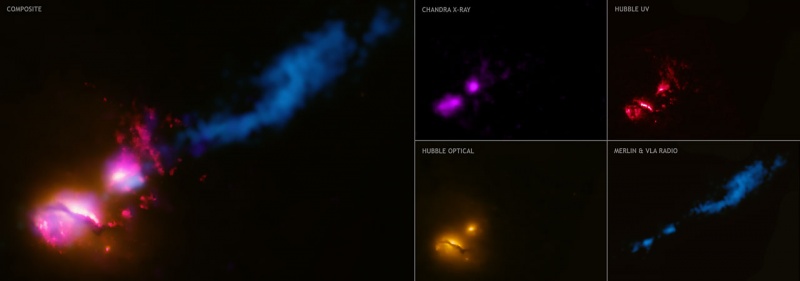
HH 7, 8, 9, 10, and 11 are five Herbig-Haro objects within NGC 1333. They are thought to have been formed by collisions of the jets from the young star SVS 13 with surrounding gas and dust.
AB Aurigae Auriga 7.05 531 ± 5 ly (163 ± 2 pc) 04h 55m 45.84600s +30° 33′ 04.2933″
A young Herbig Ae star. It is pre-main-sequence and has a stellar classification of A0Ve. It is 2.4 solar masses, radiating 38 times the sun's luminosity at an effective temperature of 9772 K. It is known for hosting a dust disk that may contain condensing planets or brown dwarfs. There are multiple forms of evidence for planet formation in its disk, and there is a directly imaged protoplanet candidate called AB Aur b. AB Aurigae is part of the Taurus-Auriga Association in the Taurus Molecular Cloud.
HD 169142 Sagittarius 8.16 375 ± 1 ly (114.9 ± 0.4 pc) 18h 24m 29.7800s −29° 46′ 49.3286″
Herbig Ae/Be star. Depleted of heavy elements. 7.5±4.5 million years old. Rotates slowly, has low stellar activity for a Herbig Ae/Be star. It is surrounded by a protoplanetary disk.
Luhman 16 Vela 16.20 6.503 ± 0.001 ly (1.9938 ± 0.0003 pc) 10h 49m 18.723s −53° 19′ 09.86″
Binary brown-dwarf system. Closest-known brown dwarfs, third-closest known system to the sun. Luhman 16A and B are 33.5 and 28.6 times the mass of Jupiter. They orbit each other with a period of 27 years and at a distance of 3.5 AU.
V830 Tau b Taurus 12.08-12.37 425.2 ± 0.9 ly (130.4 ± 0.3 pc) 04h 33m 10.03006s +24° 33′ 43.2555″
Unconfirmed exoplanet orbiting V830 Tauri (a T Tauri star). It was found on June 20, 2016 via radial velocity. It is among the youngest exoplanets, only 2 million years old. It is 0.77 times the mass of Jupiter and 0.057 AU away from its host star.
V 1298 Tau b Taurus 10.31-10.43 354 ± 2 ly (108.5 ± 0.7 pc) 04h 05m 19.59121s +20° 09′ 25.5635″
Exoplanet orbiting V1298 Tauri. It is less than 2.2 Jupiter masses and has a semimajor axis of 0.1688 ± 0.0026 AU. Its orbital period is 24.1396 ± 0.0018 days.
WASP-18b Phoenix 410 ly (130 pc)
A hot Jupiter extrasolar planet with a mass of 10 Jupiter masses. Its orbital period is less than one day and it is 0.021 AU away from its host star. There were traces of water detected by the James Webb Space Telescope, and using JWST astronomers were able to map the temperature across its dayside. It is expected to spiral toward and merge with WASP-18 because of tidal deceleration. The planet was discovered on August 27, 2009 by a team led by Coel Hellier.
WASP-39b Virgo 700 ly
Officially called Bocaprins, this is a "hot Jupiter" extrasolar planet. It was discovered in February 2011 by the WASP project and detected by primary transit. It has a considerable amount of water in its atmosphere. It is the first planet discovered to have carbon dioxide in its atmosphere, and the first for sulfur dioxide as well. WASP-39b has a mass of ~0.28 Jupiter masses and 1.27 Jupiter radii. It reaches temperatures of up to 1173 K. 0.0468 AU away from its host star, it orbits every 4 days. It has a very low density of 0.18±0.04 g/cm3.
WASP-43b Sextans 261 ly (80 pc)
Officially named Astrolábos. It is a transiting planet orbiting WASP-43. It is a hot Jupiter with twice the mass of Jupiter but roughly the same radius. The CORALIE spectrograph at La Silla Observatory, Chile, confirmed its existence via radial velocity measurements. The discovery was published on April 15, 2011. It has an orbital period of approximately 0.8 days and is 0.01526 AU away from its star. Using the Hubble Space Telescope, astronomers have mapped the temperature on the exoplanet and detected water vapor.
HR 8799 Pegasus 5.964 2.98±0.08 133.3 ± 0.2 ly (40.88 ± 0.08 pc) 23h 07m 28.7157s +21° 08′ 03.311″
A 30 million year old main-sequence star. It has 1.5 solar masses and 4.9 solar luminosities. It is part of a system containing a disk of debris and has at least four large planets orbiting it. These planets were the first exoplanets whose orbital motion was confirmed by direct imaging. This star is a Gamma Doradus variable (luminosity changes because of non-radial pulsations). It is also classified as a Lambda Bootis star (surface layers lack iron peak elements).
Beta Pictoris Pictor 3.861 2.402 63.4 ± 0.1 ly (19.44 ± 0.05 pc) 05h 47m 17.1s −51° 03′ 59″
This is the second brightest star in Pictor. It has 1.75 solar masses and 8.7 solar luminosities. It is 20-26 million years old in its main sequence. It has two planets, Beta Pictoris b and Beta Pictoris c, which have both been directly imaged. The star has an excess of infrared emission due to the debris disk around it, which was the first debris disk to be imaged.
2M 1207 Centaurus 20.15 211 ± 2 ly(64.7 ± 0.5 pc) 12h 07m 33.47s −39° 32′ 54.0″
This is a brown dwarf. A companion object, 2M1207b, may be the first extrasolar planetary-mass companion to be directly imaged. 2M1207 was discovered during the 2MASS infrared sky survey. It is very young and probably a member of the TW Hydrae association. It has a mass of around 25 Jupiter masses.
TRAPPIST-1 Aquarius 18.798±0.082 40.66 ± 0.04 ly (12.47 ± 0.01 pc) 23h 06m 29.368s −05° 02′ 29.04″
Cool red dwarf star with seven known exoplanets. Its radius is slightly larger than that of Jupiter's and has a mass that is 9% of the sun's. It is estimated to be 7.6 billion years old. Its discovery was published in 2000. Observations from the Transiting Planets and Planetesimals Small Telescope (TRAPPIST) at La Silla Observatory, Chile in 2016 resulted in the discovery of two terrestrial planets orbiting the star. Life may be possible in this star system.

Previous DSO Lists

2023 DSOs
2023 DSOs
Name Images Constellation Magnitude Distance Coordinates External Links
Apparent Absolute Right Ascension Declination
AG Carinae Carina
Classified as a Luminous Blue Variable, one of the brightest stars in the Milky Way.
GW170817
A gravitational wave detected on August 17, 2017. It originated from NGC 4993, and is the result of two neutron stars spiraling together and merging.
PSR J2030+4415
R Hydrae
R Aquarii
NGC 7027
RS Puppis
NaSt1
HD 184738 (Campbell's Hydrogen Star)
W Virginis
G344.7-0.1
SS Cygni
E0102-72.3
47 Tucanae
This object was removed from the DSO list per a rule clarification posted 10/19/22.
47 Tucanae X9 SIMBAD
SN 2008D
2022 DSOs
2022 DSOs
Name Images Constellation Magnitude Distance Coordinates External Links
Apparent Absolute Right Ascension Declination
HOPS 383 Orion 1,400 ly (420 pc) 5h 35m 29.81s −4° 59′ 51.1″ Chandra
HOPS 383 is a protostar surrounded by a shell of dust. In December 2017, the young protostar underwent an X-Ray flare.
HH 24-26 Orion 1300 ly 05h 46m 07.34s −00° 13′ 31.3″ APOD
HH24-26 is a molecular cloud and star-forming region that contains the Herbig-Haro objects HH 24, HH 25, and HH 26 originating from three protostars, as well as a very high concentration of jets.
V1331 Cyg Cygnus +11.99 1800 ly 21h 01m 09.210s +50° 21′ 44.77″ phys.org
V1331 Cyg is a young star surrounded by an interesting ring-shaped structure, with an interesting missing arc from the ring.
HBC 672 Serpens Cauda 18h 29m 56.88s +01° 14′ 46.34″ NASA
HBC 672 is a young star surrounded by a planet-forming disk that is moving and warping. The warping may be caused by a planet pulling on the disk.
Orion Nebula Orion +4.0 1,344 ly 05h 35m 17.3s −05° 23′ 28″ Chandra Hubble
The Orion Nebula is a star-forming region in Orion.
Alpha Tauri (Aldebaran) Taurus +0.85 -0.641 65 ly 04h 35m 55.24s +16° 30′ 33.49″
Alpha Tauri is a K5 star on the red giant branch and is a slow irregular variable of type Lb.
RR Lyrae Lyra 841 ly 19h 25m 27.91s +42° 47′ 03.69″
RR Lyrae is a low-mass Population II variable star and is the prototype star for the RR Lyrae class of variables.
Omicron Ceti (Mira) Cetus 02h 19m 20.79s -02° 58′ 39.50″
Omicron Ceti is a binary star system consisting of Mira A, a red giant on the asymptotic giant branch and the prototype star for the Mira class of variables, and Mira B, a white dwarf.
Abell 36 (ESO 577-24) Virgo +12.2 to +14.3 1400 ly 13h 40m 41.35s -19° 52′ 55.32″
ESO 577-24 is a planetary nebula surrounding the white dwarf Abell 36.
IC 4593 Hercules 7800 ly 16h 11m 44.55s +12° 04′ 17.03″
IC 4593 is a planetary nebula with a central bubble of ultra-hot gas at a temperature above 1 million K and a central point X-ray source.
U Antliae Antlia 910 ly 10h 35m 12.85s -39° 33′ 45.32″
U Antliae is a carbon star and red giant on the asymptotic giant branch surrounded by large shells of dust.
LP 40-365 Ursa Minor +15.51 +8.14 2061 ly (632 pc) 14h 06m 35.42s +74° 18′ 58.01″
LP 40-365, also known as GD 492, is a white dwarf composed almost entirely of metals that is thought to be the core remnant of a star that has gone supernova. It is moving extremely quickly and will likely escape the Milky Way altogether.
ASASSN-16oh Hydrus 200,000 ly 01h 57m 43.80s -73° 37′ 32.39″
ASASSN-16oh is a binary system with a white dwarf accreting mass at the highest rate ever observed, causing it to release "supersoft" X-rays.
V Sagittae Sagittarius 7800 ly 20h 20m 14.69s +21° 06′ 10.44″
V Sagittae is a binary system consisting of a main sequence star and a white dwarf. The system has brightened significantly in the past century and is expected to go supernova around the year 2083.
AR Scorpii Scorpius 380 ly 16h 21m 47.28s -22° 53′ 10.39″
AR Scorpii is a binary pulsar exhibiting strong variations in optical, ultraviolet, and radio wavelengths (a first for a white dwarf), caused when the pulsar's beam sweeps across its partner red dwarf and the energy is re-emitted.
SDSS 1035+0551 Sextans 10h 35m 33.02s +05° 51′ 58.35″ SIMBAD
SDSS 1035+0551 is a "dead cataclysmic variable," a binary system consisting of a white dwarf accreting mass from a substellar brown dwarf. These systems are thought to be common, but this is the first definite detection of one.
Tycho's SNR Cassiopeia 00h 25m 21.5s +64° 08′ 27″
Tycho's SNR is a Type Ia supernova remnant from a supernova observed in 1572 that was caused by a white dwarf accreting mass from its companion red giant.
2021 DSOs
2021 DSOs
Name Images Constellation Magnitude Distance Coordinates External Links
Apparent Absolute Right Ascension Declination
SN UDS10Wil Cetus 10.5 Gly, 3.2 Gpc 02h 17m 46.3s -05° 15′ 24.00″ Hubble
SN UDS10Wil is the furthest supernova so far of the type used to measure cosmic distances. It was discovered by the Hubble Space Telescope and was discovered as part of a three-year Hubble program that started in 2010 to survey faraway Type 1a supernovae known as the CANDELS survey.
NGC 2623 Cancer 13.36 250 Mly, 76.7 Mpc 08h 38m 24.1s +25° 45′ 16.70″
NGC 2623 is the result of a major collision and subsequent merger between two galaxies. The merger is going through late stages and is thought to eventually resemble what the Milky Way will look like when it collides with our neighboring galaxy, Andromeda in 4 billion years.
GRB 150101B Virgo 1.7 Gly, 0.52 Gpc 12h 32m 04.96s −10° 56′ 00.7″ Chandra

SIMBAD

GRB 150101B is a likely merger of 2 neutron stars 1.7 billion light years from Earth. It is fairly similar to GW170817, the first source shown to emit gravitational waves and light.
JKCS 041 Cetus ~9.9 Gly, ~ 3.04 Gpc 02h 26m 44s −04° 41′ 37″ Chandra
JKCS 041 is a group of galaxies about 9.9 billion light years. it is the farthest galaxy group from Earth discovered. It has a redshift of 1.9.
MACS J0717.5+3745 Auriga 5.4 Gly, 1.7 Gpc 07h 17m 36.50s +37° 45′ 23″ Chandra
MACS J0717.5+3745 is a massive galaxy cluster where 4 galaxy subclusters are colliding.
MACS J1149.5+2223 Leo Approximately 5 billion light-years 11h 49m 36.3s +22° 23′ 58.1″ Chandra

Frontier Fields

MACS J1149.5+2223 is a galaxy cluster which bends light from more distant objects due to its huge mass through gravitational lensing.
Bullet Cluster (1E 0657-56) Carina 3.7 billion light-years, 1.141 Gpc 06h 58m 37.9s −55° 57′ 0″
The Bullet Cluster is a system of two colliding galaxy clusters. Most of its mass is concentrated around galaxies instead of gas, which could be evidence for the existence of dark matter.
H1821+643 Draco 14.24 3.4 Gly, 1.0 Gpc 18h 21m 57.24s +64° 20′ 36.23″ Chandra

SIMBAD

H1821+643 is a luminous quasar which has been used to search for the WHIM. At its core is one of the most massive black holes known.
GOODS-S 29323 Fornax 13.2 Gly, 4.05 Gpc 03h 32m 28s –27° 48′ 30″ Chandra
GOODS-S 29323 is a direct collapse black hole seed candidate. It could support a model of SMBH formation which would allow them to form quickly in the early universe.
H2356-309 Sculptor Approximately 2 billion light-years 23h 59m 07.9s -30° 37′ 41.00″ Chandra

SIMBAD

H2356-309 is a blazar which was used to detect WHIM (in the form of an oxygen absorption line) in the Sculptor Wall.
PSS 0133+0400 Pisces Approximately 10.1 billion light-years 01h 31m 04.8s +03° 45′ 37.8″ Chandra
PSS 0133+0400 is a quasar which was used in a study to find out that the strength or amount of dark energy may be increasing.
PSS 0955+5940 Ursa Major Approximately 10.2 billion light-years 09h 51m 37.4s +59° 54′ 43.6″ Chandra
PSS 0955+5940 is a quasar which was used in the same study as PSS 0133+0400.
GW151226 Approximately 1.4 billion light-years N/A N/A LIGO
GW151226 was a Gravitational-Wave signal observed by the twin detectors of the Laser Interferometer Gravitational-Wave Observatory (LIGO) on December 26, 2015 at 03:38:53 UTC making it the second definitive observation of a merging binary black hole system detected by the LIGO Scientific Collaboration and Virgo Collaboration.
M87 Virgo 7.19 53.5 ± 1.6 Mly, 16.4 ± 0.5 Mpc 12h 30m 49.42338s +12° 23′ 28.0439″ Chandra
M87 is a nearby elliptical galaxy with an active galactic nucleus. The central SMBH of M87 was imaged by the Event Horizon Telescope as the first black hole to be imaged.
3C 273 Virgo 12.9 2.443 Gly, 749 Mpc 12h 29m 06.7s +02° 03′ 09″ AAVSO

Chandra

3C 273 is the most optically bright quasar, and also one of the closest, in our night sky. Along with 3C 48, it was the first object to be identified as what we now know to be quasars.
DLA0817g Cancer 12.276 Gly, 3.764 Gpc 08h 17m 40.86s +13° 51' 38.2" NRAO
DLA0817g is the oldest and farthest known disk galaxy.


2021 DSO Surveys (Surveys)
Name Images Area Surveyed Instrument(s) Wavelength(s) Objects External Links
Chandra Isotropic Universe Survey Full Sky Chandra X-Ray Observatory, XMM-Newton X-Ray Galaxy Clusters Chandra
The purpose of this survey is to explore whether or not the universe is isotropic. It uses X-Ray luminosity of galaxy clusters to calculate expansion speeds across the sky.
Hubble CANDELS Survey ~800 square arcmin Hubble Space Telescope Near-Infrared to Mid-Ultraviolet Distant Galaxies NASA
The purpose of the Cosmic Assembly Near-infrared Deep Extragalactic Legacy Survey is to collect data on the first third of galactic evolution by imaging galaxies of redshift 1.5-8. This survey also measures supernovae with a redshift of 1.5 or greater to test their accuracy as standard candles for cosmology.
2020 DSOs
2020 DSOs
Name Images Constellation Magnitude Distance Coordinates External Links
Apparent Absolute Right Ascension Declination
SN UDS10Wil Cetus 10.5 Gly, 3.2 Gpc 02h 17m 46.3s −05° 15′ 24.00″
SN UDS10Wil is the furthest supernova so far of the type used to measure cosmic distances. It was discovered by the Hubble Space Telescope and was discovered as part of a three-year Hubble program that started in 2010 to survey faraway Type 1a supernovae known as the CANDELS survey.
NGC 2623 Cancer 13.36 250 Mly, 76.7 Mpc 08h 38m 24.1s +25° 45′ 16.70″
NGC 2623 is the result of a major collision and subsequent merger between two galaxies. The merger is going through late stages and is thought to eventually resemble what the Milky Way will look like when it collides with our neighboring galaxy, Andromeda in 4 billion years.
GRB 150101B Virgo 1.7 Gly, 0.52 Gpc 12h 32m 04.96s −10° 56′ 00.7″ Chandra

SIMBAD

GRB 150101B is a likely merger of 2 neutron stars 1.7 billion light years from Earth. It is fairly similar to GW170817, the first source shown to emit gravitational waves and light.
JKCS 041 Cetus ~9.9 Gly, ~ 3.04 Gpc 02h 26m 44s −04° 41′ 37″ Chandra
JKCS 041 is a group of galaxies about 9.9 billion light years. it is the farthest galaxy group from Earth discovered. It has a redshift of 1.9.
MACS J0717.5+3745 Auriga 5.4 Gly, 1.7 Gpc 07h 17m 36.50s +37° 45′ 23″ Chandra
MACS J0717.5+3745 is a massive galaxy cluster where 4 galaxy subclusters are colliding.
MACS J1149.5+2223 Leo ~5 billion light-years 11h 49m 36.3s +22° 23′ 58.1″ Chandra

Frontier Fields

MACS J1149.5+2223 is a galaxy cluster which bends light from more distant objects due to its huge mass through gravitational lensing.
Bullet Cluster (1E 0657-56) Carina 3.7 billions light-years, 1.141 Gpc 06h 58m 37.9s −55° 57′ 0″
The Bullet Cluster is a system of two colliding galaxy clusters. Most of its mass is concentrated around galaxies instead of gas, which could be evidence for the existence of dark matter.
H1821+643 Draco 14.24 3.4 Gly, 1.0 Gpc 18h 21m 57.24s +64° 20′ 36.23″ Chandra

SIMBAD

H1821+643 is a luminous quasar which has been used to search for the WHIM. At its core is one of the most massive black holes known.
GOODS-S 29323 Fornax 13.2 Gly, 4.05 Gpc 03h 32m 28s –27° 48′ 30″ Chandra
GOODS-S 29323 is a direct collapse black hole seed candidate. It could support a model of SMBH formation which would allow them to form quickly in the early universe.
H2356-309 Sculptor ~2 billion light-years 23h 59m 07.9s -30° 37′ 41.00″ Chandra

SIMBAD

H2356-309 is a blazar which was used to detect WHIM (in the form of an oxygen absorption line) in the Sculptor Wall.
152156.48+520238.5 Boötes ~10.75 billion light-years 15h 21m 56.5s +52° 02′ 38.50″ Chandra
152156.48+520238.5 is a quasar which has similar properties to the quasar PHL 1811. The disk around it may be puffed up (from high accretion rates), causing it to be fainter in X-rays and have weak emission lines.
153714.26+271611.6 Corona Borealis ~11.03 billion light-years 15h 37m 14.3s +27° 16′ 11.6″ Chandra
153714.26+271611.6 is a quasar similar to PHL 1811. Like 152156.48+520238.5, it has weak emission lines probably caused by a puffed-up accretion disk.
222256.11-094636.2 Aquarius ~11.48 billion light-years 22h 22m 56.10s -09° 46′ 36.20″ Chandra
222256.11-094636.2 is a quasar similar to PHL 1811. Like 152156.48+520238.5, it has weak emission lines and weak X-ray emission, likely caused by a puffed-up disk.
PSS 0133+0400 Pisces ~10.1 billion light-years 01h 31m 04.8s +03° 45′ 37.8″ Chandra
PSS 0133+0400 is a quasar which was used in a study to find out that the strength or amount of dark energy may be increasing.
PSS 0955+5940 Ursa Major ~10.2 billion light-years 09h 51m 37.4s +59° 54′ 43.6″ Chandra
PSS 0955+5940 is a quasar which was used in the same study as PSS 0133+0400.
GW151226 ~1.4 billion light-years N/A N/A LIGO
GW151226 was a Gravitational-Wave signal observed by the twin detectors of the Laser Interferometer Gravitational-Wave Observatory (LIGO) on December 26, 2015 at 03:38:53 UTC making it the second definitive observation of a merging binary black hole system detected by the LIGO Scientific Collaboration and Virgo Collaboration.
Messier_87 Virgo 7.19 53.5 ± 1.6 Mly, 16.4 ± 0.5 Mpc 12h 30m 49.42338s +12° 23′ 28.0439″ Chandra
M87 is a nearby elliptical galaxy with an active galactic nucleus. The central SMBH of M87 was imaged by the Event Horizon Telescope as the first black hole to be imaged.
3C 273 Virgo 12.9 2.443 Gly, 749 Mpc 12h 29m 06.7s +02° 03′ 09″ AAVSO

Chandra

3C 273 is the most optically bright quasar, and also one of the closest, in our night sky. Along with 3C 48, it was the first object to be identified as what we now know to be quasars.
2019 DSOs
2019 DSOs
Name Images Constellation Magnitude Distance Coordinates External Links
Apparent Absolute Right Ascension Declination
NGC 5195 Canes Venatici 10.5 25 Mly, 7.7 Mpc 13h 29m 59.6s +47° 15′ 58″
A dwarf galaxy that is interacting with the Whirlpool Galaxy. Because of its interaction with the Whirlpool Galaxy, it is highly distorted. In the picture, the Whirlpool Galaxy is on the left and NGC 5195 is the smaller galaxy to the right.
IC 10 Cassiopeia 10.4 2.2 Mly, 660 kpc 00h 20m 17.3s +59° 18′ 14″
An irregular starburst galaxy featuring a large amount of Wolf-Rayet stars.
SPT 0346-52 Horologium 12.7 billion light years 03h 46m 41.13s -52° 05' 02.11" Chandra
A starburst galaxy that resulted from a collision between two galaxies. It has one of the highest star formation rates of any galaxy.
Messier 81/Messier 82 Ursa Major 6.94 8.5 ± 1.3 Mly (2.6 ± 0.4 Mpc) 09h 55m 33.2s +69° 3′ 55″
M81, also known as "Bode's Galaxy", is a large spiral galaxy. It is the center of the M81 group. M82, also known as the "Cigar Galaxy", is a starburst galaxy in the same group as M81 (same region of sky).
ESO 137-001 Triangulum Australe Unknown apparent magnitude; apparent size 1.23 arcminutes × 0.55 arcminutes 220 million ly 16h 13m 27.305s −60° 45′ 50.59″
ESO 137-001 is a barred spiral galaxy. As the galaxy moves to the center of the Abell 3627 cluster at 7 million kilometers per hour, it is stripped by hot gas thus creating a 260,000 light-year long tail. The intergalactic gas in the Abell 3627 is 180 million degrees Fahrenheit which causes star formation in the tails.
SN 2014J Ursa Major N/A N/A 11,500,000 ly (3,500,000 pc) 9h 55m 42.217s 69° 40′ 26.56″
SN 2014J was a type-Ia supernova in Messier 82 (the 'Cigar Galaxy', M82) discovered in mid-January 2014 by chance during an undergrad astronomy course at the University of London Observatory. It was the closest type-Ia supernova discovered for 42 years, and none have been closer as of 2018.
Phoenix Cluster Phoenix 5.7 billion light years 23h 44m 40.9s −42° 41′ 54″
The Phoenix Cluster (SPT-CL J2344-4243) is a massive, type I galaxy cluster in the Phoenix Constellation. It is one of the most massive galaxy clusters known, with the mass on the order of 2×10¹⁵ M☉. Most of the mass of the Phoenix Cluster is in the form of dark matter and its intracluster medium. The vast stellar halo of the Phoenix Cluster central galaxy extends to over 1.1 million light years from the center, making it one of the largest galaxies known. It is 22 times the diameter of our galaxy, and its starburst activity suggests that the galaxy is still growing larger. More X-Ray production than any other massive cluster.
NGC 4993 Hydra 13.32 -20.85 44.1 Mpc (144 Mly) / 130.5 million light years 13h 09m 47.7s −23° 23′ 02″
NGC 4993 is the site of the first astronomical event detected in both electromagnetic and gravitational radiation, the collision of two neutron stars, an event that provided direct confirmation that binary neutron star collisions produce short gamma-ray bursts.
47 Tucanae Tucana +4.09 4.0 ± 0.35 kpc (13,000 ± 1,100 ly) 00h 24m 05.67s –72° 04′ 52.6″
47 Tucanae, 47 Tuc (or NGC 104) is a globular cluster that is 120 light years across. 47 Tuc can be seen with the naked eye, holding the position of second brightest globular cluster after Omega Centauri. X9 (closest orbit between star and black hole, containing a white dwarf and a stellar-mass black hole in orbit).
Chandra Deep Field South Fornax N/A N/A N/A 3h 32m 28.0s −27° 48′ 30″ N/A
The Chandra Deep Field Survey South is a photograph taken for over 8 million seconds exposure by the Chandra Deep Field Telescope. It contains at least 5,000 black holes, which makes it a topic of interest for astronomy.
Centaurus A Centaurus 6.84 13h 25m 27.6s −43° 01′ 09″
Either an elliptical or lenticular galaxy. One of the closest and brightest radio galaxies to Earth, and is a starburst galaxy. contains a black hole in the middle roughly at 55 million stellar masses. By taking radio observations of the jet separated by a decade, astronomers have determined that the inner parts of the jet are moving at about half of the speed of light. X-rays are produced farther out as the jet collides with surrounding gases resulting in the creation of highly energetic particles. The X-ray jets of Centaurus A are thousands of light-years long, while the radio jets are over a million light-years long.
Messier 100 Coma Berenices 9.5 55 Mly 12h 22m 54.9s +15° 49′ 21″
Messier 100 is a Grand Design intermediate spiral galaxy, which also is classified as a starburst galaxy. It is located in the Virgo cluster. The galaxy is estimated to contain about 400 billion stars.
Abell 400/3C 75 Cetus 100 Mpc (326 Mly) 02h 57m 38.6s +06° 02′ 00″
Abell 400 is a galaxy cluster which contains the galaxy NGC 1128 with two supermassive black holes (3C 75) spiraling towards merger. The black holes are an estimated 25,000 light years apart, and thus will take millions of years to collide. Should the two supermassive black holes merge, they will form a single super-supermassive black hole. 3C-75, the system containing the black holes, has four radio jets (two from each accreting black hole). It is travelling at 1200 kilometers per second through the cluster plasma, causing the jets to be swept back.
Antennae Galaxies (NGC 4038 & NGC 4039) Corvus 11.2 / 11.1 45 Mly / 65 Mly 12h 01m 53.0s / 12h 01m 53.6s −18° 52′ 10″ / −18° 53′ 11″
NGC 4038/NGC 4039 are a pair of interracting galaxies currently undergoing Starburst, in which the collision of gas and dust are influencing accelerated star formation. The nuclei of galaxies are expected to eventually form a single larger galaxy.
Sagittarius A* Sagittarius N/A N/A 7,860 ± 140 ± 40 pc 17h 45m 40.0409s −29° 0′ 28.118″
Sgr A is a complex radio source in the center of the Milky Way galaxy. It is shrouded at optical wavelengths by hydrogen clouds, however can be detected due to it's large compact radio signature. Consists of three components: Sagittarius A East, a supernova remnant, Sagittarius A West, a spiral structure, and a complex radio signature in the center Sagittarius A*, which is assumed to be a supermassive black hole.
2018 DSOs
2018 DSOs
Name Images Constellation Magnitude Distance Coordinates External Links
Apparent Absolute Right Ascension Declination
AG Carinae Carina 6.96 ~-8 (visible band) 6000 parsecs 10h 56m 11.58s -60° 27’ 12.8056" SIMBAD AAVSO
One of the brightest stars in the Milky Way, surrounded by a nebula. Apparent brightness can vary drastically between 5.7 and 8.3. This star is considered in transition from a blue supergiant to a WR-star.
Betelgeuse (Alpha Orionis) Orion 0.2-1.2 ~643 ly 05h 55m 10.3053s +07° 24' 25.426" AAVSO
More commonly known as Betelgeuse, this semi-regular (SRc) pulsating red supergiant will likely explode as a type II supernova within the next million years.
ASASSN-15lh Indus 16.9 -23.5 (ultraviolet band) 1,171 megaparsecs 22h 2m 15.45s -61° 39’ 34.64”
Supernova detected by the All Sky Automated Survey. It is either the most luminous type I supernova ever discovered, called a hypernova, or a tidal disruption event.
Circinus X-1 Circinus 21.40 15h 20m 40.85s −57° 10′ 00.1″
Neutron star orbiting a conventional super-massive star.
DEM L241 Chandra
Geminga Gemini 815 ly 06h 33m 54.15s +17° 46′ 12.9″ Chandra
Geminga is likely a decaying core of a Type II Supernova. It is highly visible in the gamma-ray spectrum.
HR 5171 A Centaurus 6.1 - 7.5 ~13,000 ly 13h 47m 10.864s −62° 35′ 22.95″
IC 443 Gemini, near Eta Geminorum 5000 ly, 1.5 kpc 06h 17m 13s +22° 31′ 05′′
IC 443 is a remnant of a supernova that likely occurred 3000-30,000 years ago. It is one of the best-studied cases of a supernova remnant interacting with the surrounding molecular clouds.
M82 X-2 Ursa Major 12 million ly, 3.5 million pc 09h 55m 51.0s 69° 40′ 45″
M-82 X-2, an X-ray pulsar in the Messier 82 galaxy, is noted for being an ultra luminous X-ray source (ULX), shining around 100x brighter than predicted. It is part of a binary system, where it revolves around the larger star about once every 2.5 days. It rotates about once every 1.37 seconds. It was uncovered by NuSTAR and verified by the Chandra and Swift spacecraft.
NGC 6357 Scorpius ~5500 ly, ~1680 pc 17h 25m 34.2s −34° 23′ 12"
NGC 6357 is a diffuse nebula. It is also named the War and Peace nebula, because infrared pictures appear to depict a dove and a skull, and the Lobster nebula. It includes the Pismis cluster, containing a number of massive stars, as well as two young stellar clusters, G353.2+0.7 and G353.1+0.6. It is one of the most important sites of massive star formation in the Milky Way.
NGC 7822 Cepheus 2900 ly, 900 pc 00h 01m 08.58s +67° 25′ 17.0″
NGC 7822 is a star forming region that is believed to be relatively young. It contains the star BD+66 1673, one of the hottest stars discovered within 1 kpn of the Sun, and is noted for its elephant trunk-shaped pillars of creation. Description of the DSO, important characteristics, etc.
PSR B0355+54 Chandra
RCW 103 Norma 10110 to 10760 ly, 3100 to 3300 pc 16h 17m 30s -51° 02′
RCW 103 is a supernova remnant containing the neutron star 1E 161348-5055 at its center. This neutron star is notable for having a spin period much longer than other observed pulsars and much longer than what is predicted based on its age.
S Doradus Dorado 8.6-11.5 -10.0 169000 ly, 51.8 kpc 05h 18m 14.3550s −69° 15′ 01.151″
First observed in 1897, S Dor is a Luminous Blue Variable (LBV) located in the Large Magellanic Cloud (LMC). It is also the brightest member of NGC 1910, an open cluster. An entire class of variable stars are named after this DSO, which have the unusual characteristic of short-term microvariations superimposed over long-term macrovariations.
SN 1987A Dorado Peaks around +2.9 168,000 ly, 51.4 kpc 05h 35m 28.03s −69° 16′ 11.79″
The closest observed supernova since SN 1604, its light reached the Earth 23 February 1987. It was the first opportunity for astronomers to study the development of a supernova and learn more about core-collapse supernovae. Additionally, it detected gamma-ray radiation that proved that the post-explosion glow is radioactive. This was also the first supernova where astronomers were able to directly observe emitted neutrinos.
SN W49B Aquila 33,000 ly, 10 kpc 19h 11m 09s +09° 06′ 24″ Chandra Chandra (picture)
One of the most luminous SNRs in the galaxy at gamma-ray wavelengths, SN W49B also shows Cr and Mn x-ray emissions and has asymmetrically distributed Fe and Ni. It is thought to have left a black hole at the center - possibly the most recent black hole formed in the Milky Way.
2017 DSOs
2017 DSOs
Name Images Constellation Magnitude Distance Coordinates External Links
Apparent Absolute Right Ascension Declination
Henize 2-428 Aquilla 19h 13m 05.239s +15° 46′ 39.80″ Space.com
Heaviest known WD binary system ;Will eventually merge in 700 million years; Originally binary star system of two sun-like stars of equivalent mass; Total mass 1.8 M_sun; Nebula is asymmetric because of binary system at center instead of single star; The planetary nebula came from the outer later of the original star, from contraction/expansion during the Red Giant stages; Period is 4 hours; Emit gravitational waves resulting in loss of energy; Will eventually cause Type 1a supernova when they merge, absolute magnitude =/= -19.3 because of increased mass: will not be useful as standard candle.
Henize 3-1357 (Stingray Nebula) Ara 10.75 -3.0 18kly 17h 16m 21.071s −59° 29′ 23.64″ APOD NASA Gallery
Youngest known planetary nebula; Radius 0.02 pc (as large as 130 solar systems), separated by 0.3arcsec; Age 2650 yr, gases light up for no more than 40 yr; Core mass 0.59 M_sun; ionized mass (nebula mass) 0.2Msol; Star at the center was originally a asymptotic giant branch B1 supergiant, still evolving to WD; White dwarf has strong hydrogen rich Balmer lines; Luminosity 3000 L_sun.
HM Cancri (RX J0806.3+1527) Cancer 21.1 ~1600 ly 08h 06m 23.20s +15° 27' 30.20" Chandra Space.com
Period 321.5 seconds: shortest period known; proper motion 1.1mas/yr; separation 0.0005 A; 400,000 km/sec, approaching at 2.0ft/day and orbit decaying at 1.2 ms/yr; total mass of 1.18 M_sun assuming separation of 1.02 x 10 -6 arcseconds; Double WD system, releases gravitational wave; X-Ray binary; X-Rays originate from accretion flow crashing into magnetic poles of white dwarf.
J075141/J174140 (two objects) Monceros/Draco 07h 51m 41.20s/17h 41m 40.50s -01° 41' 20.90"/+65° 26' 38.70" Chandra
Binary system; white dwarf with a companion star; theoretically give off gravitational waves; Potentially may not create Type 1a Supernova, maybe a Type 1ax or .Ia Supernova, where detonation only on surface of star.
M15 Pegasus 6.2 -9.2 ~33,600 ly 21h 29m 58.33s +12° 10′ 01.2″ Messier Catalogue UAlabama APOD
M15 is one of the oldest known and closest globular clusters to Earth. It is potentially one of the densest clusters known, containing over 100,000 stars with 112 variables, 8 pulsars, and 1 double neutron star system which gives off X-rays. It contains a planetary nebula called Pease 1, which shows that stellar evolution still takes place in globular clusters.
NGC 1846 Dorado 160,000ly 05h 07m 33s -67° 27' 41" NASA
NGC 1846 is a globular cluster with an unusual HR diagram: there are two turn-off points. Stars in a globular clusters form at the same time, meaning that the after the turnoff point there should be few stars. There are two different populations of stars in the clusters, with calculated age difference of around 300 million years, which is suspected to be caused by a merge of 2 globular clusters. Additionally, there is a potential planetary nebula within the cluster.
NGC 2392 (Eskimo Nebula) Gemini 10.1 0.4 ~3000 ly 07h 29m 10.7669s +20° 54′ 42.488″ APOD
NGC 2392 is a double shell planetary nebula often called the Eskimo nebula. The rings of the nebula are formed by the collision of fast and slow moving gases. The nebula is about 10,000 years old, and will last about another 50,000 years before it cannot be seen. The high X-ray emission could be potentially due to an unseen companion star. Notable features include strong OIII lines and weak Hα lines.
NGC 2440 Puppis 9.4 07h 41m 54.91s −18° 12′ 29.7″ NASA APOD Chandra
NGC 2440 is a planetary nebula containing the hottest known white dwarf, HD62166. The white dwarf itself has a temperature of 200,000K, and is surrounded by cooling gas. Most light is emitted in UV, ionizing the surrounding material. Its multipolar structure could potentially be caused by the shedding of mass in different locations or precession.
Omicron Ceti (Mira) Cetus 3.04 -5.04 to -5.16 ~420 ly 02h 19m 20.79210s –02° 58′ 39.4956″ Chandra NASA Science News
Mira is the prototype for Mira variables, which are red giants that oscillate over long periods. It is a binary star system, with Mira A the red giant on the asymptotic giant branch that is losing mass and Mira B the white dwarf that is accreting mass. Historically, it was the first non-supernova variable star discovered. Mira A(?) is not spherical, rather it is egg shaped due to the non-radial nature of its pulsations. Additionally, it exhibits a bow shock, which was only recently discovered due to the need for high tech observatories in UV. Mira has been observed in almost all frequencies, each having seemingly different shapes and giving specific information about the star.
Sirius A & B Canis Major -1.46 1.42 8.6ly 06h 45m 09s −16° 42′ Chandra APOD
Sirius A and B are collectively the brightest star in the sky. Sirius A is a type A1 star, and Sirius B is a white dwarf. Sirius B was originally a bright blue star, which then shed its outer layers and became a white dwarf with broad hydrogen absorption lines. Their separation is 20 AU. Sirius A emits more radiation in the visible spectrum, while Sirius B emits more radiation in the X-ray spectrum.
SN2011fe Ursa Major +9.9 -19 21 Mly 14h 03m 05.8s +54° 16′ 25″ NASA AAVSO
SN 2011fe is the youngest Type 1a Supernova discovered. Discovered by the Palomar Transient Factory in 2011, it was used to test predictions and models of Type 1a supernovae. The progenitor was a carbon-oxygen white dwarf with a star no larger than the Sun. As with many type 1a supernovae, a large amount of energy was emitted through the decay of Ni-56. The location of the supernova was in the Pinwheel galaxy (M101).
SNR 0509-67.5 Dorado ~52,000 pc/160 kly 05.01h 09.01m 31.01s −67.01° 31.01′ 18.2″ Chandra APOD
SNR 0509-67.5 is a Type 1a supernova remnant found in the Large Magellanic Cloud. It was mostly likely a double degenerate system given the lack of companions in the vicinity. There is little doubt as to where it was a Type 1a supernovae, due to the silicon found after the explosion. It was observed through a light echo where light reflects off interstellar dust, delaying its arrival by 400 years. The outer ring is gas that has been shocked and heated by the supernova., expanding at 11,000 mph.
G1.9+0.3 Sagittarius ~7665 pcs 17h 48m 45.4s -27° 10' 06" Chandra
SNR G1.9+0.3 was most likely a double degenerate progenitor supernova. It is only 110 years old, the youngest Type Ia Supernova in the Milky Way. While the light would have reached the Earth in the 19th century, interstellar dust obscured it. However, the X-rays and radio waves were able to penetrate the gas. The remnant has a very asymmetric pattern, and exhibits synchrotron radiation (charged particles traveling in a curved path).
SS Cygni Cygnus 7.7-12.4 2.42-7.12 114 pcs 21h 42m 42.804s 43° 35' 09.88" AAVSO Chandra
A recurrent nova with a very massive white dwarf and a red dwarf-type star cooler than our sun. Often classified as U Geminorum type dwarf nova. SS Cygni is commonly thought of as the prototype dwarf nova. There are three parts to the system, the two stars and the accretion disk. The accretion disk pulsates in brightness, causing its variability. The period of the system is 6.5 hours, with outbursts every 7-8 weeks.
Tycho's SNR Cassiopeia ~9000 ly 00h 25m 17s 64° 08' 37" Chandra NASA APOD
A Type 1a supernova remnant that was observed in 1572 and later studied by Tycho Brahe. It remains one of the few supernovae visible to the naked eye. It was detected again using radio waves in 1952, and found that a G0-G2 star was the companion to the white dwarf progenitor. The companion star was most likely around 1.4 solar masses.
2016 DSOs
2016 DSOs
Name Images Constellation Magnitude Distance Coordinates External Links
Apparent Absolute Right Ascension Declination
2MASS J22282889-431026 [[]] Grus 35 ly, 10.6 pc 22h 28m 28.894s -43° 10′ 26.27″
2MASS J22282889-4310262 is a brown dwarf used to study windstorms on brown dwarfs. These investigations were the first to observe the variability in weather on brown dwarfs at different altitudes. It was discovered by the Hubble Space Telescope and the Spitzer Space Telescope in 2013.
51 Pegasi b [[]] Pegasus 5.49 50.9 ly, 14.7 pc 22h 57m 28.0s +20° 46′ 08″
51 Pegasi b (also known as Bellerophon and Dimidium) was the first exoplanet found orbiting a main-sequence star.
55 Cancri [[]] Cancer 40.3 ly 08h 52m 35.81s +28° 19′ 51.0″
AB Aurigae [[]] [[]] Auriga ~470 ly 04h 55m 45.8445s +30° 33′ 04.292″
Barnard 68 [[]] [[]] Ophiuchus 500 ly 17h 22m 38.2s -23° 49′ 34
GD 165 [[]] [[]] Bootes ~103 ly 14h 24m 39.144s +09° 17′ 13.98
HAT-P-11b [[]] [[]] Cygnus 122 ly 19h 50m 50.25s +48° 04′ 51.1″
HD 95086 [[]] [[]] Carina 296 ly 10h 57m 03s -68° 40′ 02″
HD 106906b [[]] [[]] Crux 300 ly 12h 17m 53.0s −54° 01′ 28″
HR 8799 [[]] Pegasus 129 ly 23h 07m 28.7150s +21° 08′ 03.302"
Kepler-186 [[]] [[]] Cygnus 492 ly 19h 54m 36.651s +43° 57′ 18.06″
M42 [[]] [[]] Orion 1344 ly 05h 35m 17.3s −05° 23′ 28″
HR 8799 [[]] Taurus ~600 ly 04h 21m 59.43445s +19° 32′ 06.4182″
WASP-18b [[]] [[]] Phoenix 325 ly 01h 37m 24.95s –45° 40′ 40.8″
WASP-43b [[]] [[]] Sextans ~80 pc 10h 19m 38s −09° 48′ 23″
WISE 0855-0714 [[]] [[]] Hydra 7.53 ly 08h 55m 10.83s –07° 14′ 42.5″
2015 DSOs
2015 DSOs
Name Images Constellation Magnitude Distance Coordinates External Links
Apparent Absolute Right Ascension Declination
FU Orionis Image 2 Orion ~1300 ly 05h 45m 22.362s +09° 04′ 12.31″ AAVSO
TW Hydrae Image 2 Hydra 176 ly 11h 01m 52s −34° 42′ 17″
2M1207 Image 2 Centaurus 172 ly 12h 07m 33.47s −39° 32′ 54.0″
CoRoT-2 Image 2 Aquila 930 ly 19h 27m 06.496s +01° 23′ 01.38″
HD 209458 b Image 2 Pegasus 154 ly 22h 03m 10.8s +18° 53′ 04″
HD 189733 b Image 2 Vulpecula 63.4 ly 20h 00m 43.71s +22° 42′ 39.1″
Kepler-7b Image 2 Lyra ~3400 ly 19h 14m 19.6s +41° 5′ 23.3″
GJ 1214 b Image 2 Ophiuchus 42 ly 17h 15m 18.942s +04° 57′ 49.69″
Beta Pictoris Image 2 Pictor 63.4 ly 05h 47m 17.1s −51° 03′ 59″
Fomalhaut Image 2 Piscis Austrinus 25.13 ly 22h 57m 39.0465s −29° 37′ 20.050″
HR 8799 Image 2 Pegasus 129 ly 23h 07m 28.7150s +21° 08′ 03.302″
WISE 1049-5319 (Luhman 16) Image 2 Vela 6.6 ly 10h 49m 18.723s −53° 19′ 09.86″
Gliese 229B Image 2 Lepus 18.8 ly 06h 10m 34.6154s −21° 51′ 52.715″
LP 944-20 Image 2 Fornax 20.9 ly 03h 39m 35.220s –35° 25′ 44.09″
N159 Image 2 Dorado 170000 ly 05h 40m 04.2s –69° 44′ 43″
M20 Image 2 Sagittarius 5200 ly 18h 02m 23s −23° 01′ 48″


2014 DSOs
2014 DSOs
Name Images Constellation Magnitude Distance Coordinates External Links
Apparent Absolute Right Ascension Declination
Mira (Omicron Ceti) Cetus 2.0 to 10.1 ~-2.5 to 4.7 ~420 ly 02h 19m 20.70s -02° 58' 39.51" Chandra NASA Science News
Mira is the prototype for Mira variables, which are red giants that oscillate over long periods. It is a binary star system, with Mira A the red giant that is losing mass and Mira B the white dwarf that is accreting mass.
W49B Aquila ~26,000 light years 19h 11m 07s +09° 06' 00" Chandra
W49B is an SNR that is theorized to have a distorted shape and a black hole from the explosion that created the remnant. It may be the most recent black hole formed in the Milky Way.
SN 1572 (Tycho's Supernova) Cassiopeia -4 ~9000 ly 00h 25m 17s +64° 08' 37" Chandra NASA APOD
A Type 1a supernova remnant that burst in early November 1572 and was later studied by Tycho Brahe.
Vela SNR Vela 12 ~800 ly 08h 35m 20.66s -45° 10' 35.2" APOD
The closest known supernova remnant to us with a notable pulsar and neighboring nebulae. Contains NGC 2736 or the Pencil Nebula, which is thought to have formed from part of the shock wave of the Vela SNR
G1.9+0.3 Sagittarius ~28,000 ly 17h 48m 45s -27° 10' 00" Chandra NASA
Possibly the most recent supernovae, specifically Type Ia, in the Milky Way. It has an extremely asymmetric pattern. Explosion was likely highly non-uniform and unusually energetic.
Eta Carinae Carina -0.8 to 7.9 ~7,500 ly 10h 45m 03.591s -59° 41′ 04.26″ Chandra APOD
A hypergiant with a smaller companion. Massive supernova, very bright. It has a chance of exploding at any time, and will be so bright that it rivals the moon.
SS Cygni Cygnus 7.7-12.4 370 ly 21h 42m 42.804s 43° 35' 09.88" AAVSO Chandra
A recurrent nova with a very massive white dwarf and a red dwarf-type star cooler than our sun. Often classified as U Geminorum type dwarf nova.
T Tauri Taurus 9.3-14 462 ly 04h 21m 59.43s +19° 32′ 06.42″ NASA APOD Universe Today
T Tauri is the prototype for T Tauri stars, which are the stars in the life stage between protostar and main sequence. there is a nebula located close to the star called Hind's Variable Nebula, which changes in luminosity as T Tauri varies.
GRS 1915+105 Aquila 40,000 ly 19h 15m 11.60s +10° 56' 44.00 Chandra
GRS 1915+105 is an x-ray binary star system containing a regular star and a black hole. It is one of the heaviest stellar black holes so far known in the Milky Way and has a self-regulating black hole.
47 Tucanae Tucana 4.91 16,700 ly 00h 24m 05.67s -72° 04′ 52.6″ Chandra APOD APOD
47 Tucanae is the second brightest globular cluster after Omega Centauri and one of the most massive globular clusters in the galaxy.
The Trapezium Orion 4 1,600 ly 05h 35.4m -05° 27′ Chandra APOD APOD
The Trapezium is a relatively young open cluster in the heart of the Orion Nebula.
T Pyxidis Pyxis 6.4-15.5 15,600 ly 09h 04m 41.50s -32° 22′ 47.5″ AAVSO NASA APOD
T Pyxidis is a recurrent nova and nova remnant containing a sun-like star and a white dwarf. It is now close to the Chandrasekhar limit and might soon explode as a type 1a supernova.
Abell 30 Cancer 15.6 5,500 ly 08h 46m 53.50s +17° 52' 45.40" Chandra
Abell 30 is a planetary nebula in a special, rarely-seen phase of evolution. The evolution of A30 stalled and then started up again, so the planetary nebula was reborn.
RX J0806.3+1527 (HM Cnc) Cancer 21.1 ~1600 ly 08h 06m 23.20s +15° 27' 30.20" Chandra Space.com
An x-ray binary system composed of two white dwarves that are rapidly orbiting each other. Their orbits are slowly getting closer, and the stars will eventually collide. Since they are faint, they are being observed by x-ray emissions.
V1647 Ori Orion 1,300 ly 05h 46m 13.10s -00° 06' 05.00" Chandra NASA
V1647 Ori is a FU Orionis variable star, a low-mass protostar still partly surrounded by its birth cloud. It is spinning as fast as it can without ripping itself to pieces.
V1 Andromeda 2.5 million ly 00h 41m 27s Hubblesite NASA
A Cepheid variable star in the Andromeda galaxy that began Hubble's discovery of the expansion of the universe by showing that the Andromeda galaxy was not part of our galaxy.
NGC 1846 Doradus 11.3 ~160,000 ly 05h 07m 35.25s -67° 27' 38.9" Hubblesite NASA
NGC 1846 is a globular cluster located in the outer halo of the LMC. The most intriguing object is a faint green planetary nebula, and it doesn't seem to belong in the cluster.
NGC 3132 Vela 9.87 ~2,000 ly 10h 07m 01.7640s -40° 26′ 11.060″ APOD APOD
NGC 3132 is a planetary nebula. There are two stars in the nebula, one of which is a white dwarf.
2013 DSOs
2013 DSOs
Name Images Constellation Magnitude Distance Coordinates External Links
Cassiopeia A Cassiopeia Apparent: Peak=~6 ~11,000 ly Right Ascension: 23h 23m 26.7s ; Declination: +58° 49' 3.00" Chandra
Cassiopeia A is the youngest supernova remnant in the Milky Way Galaxy.
IGR J17091 Scorpius Apparent: ~28,000 ly Right Ascension: 17h 09m 7.92s; Declination: -36° 24' 25.20" Chandra
IGR J17091 has the highest ever known wind speed at 20 million miles per hour, which is only 3% of the speed of light.
NGC 6888/ WR 136 Cygnus Apparent: +7.4 ~5,000 ly Right Ascension: 20h 12m 35.00s; Declination: +38° 26' 30.00" Chandra
NGC 6888, also known as the Crescent Nebula, was created the powerful winds coming off of the Star WR 136, or HD 192163.
PSR J0108-1431 Cetus Apparent: peak: 27.8 ~770 ly Right Ascension: 01h 08m 08.30s; Declination: -14° 31' 48.50" Chandra, Neutron Star Physics Blog
PSR J0108-1431 is, by far, the nearest pulsar, or neutron star, to Earth.
Cygnus X-1 Cygnus Apparent: 8.95 Absolute: 6.5 ~6070 ly Right Ascension: 19h 58m 21.70s; Declination: +35° 12' 05.80" Chandra, NASA
Stephen Hawking lost a bet that Cynus X-1 did not contain a black hole; This black hole is 15 times the mass of the sun.
SXP 1062 Tucana Apparent: ~180,000 ly Right Ascension: 01h 29m 12.40s; Declination: -73° 32' 01.70" Chandra
There is evidence that there is a pulsar within this supernova remnant.
Messier Object M1 (Crab Nebula) Taurus Apparent: 8.4 ~6,500 ly Right Ascension: 05h 34m 32s; Declination: +22° 0.0' 52.00" Chandra, NASA
First observed in A.D. 1054, the Crab Nebula produces the equivalent of 100,000 suns in Energy and has a pulsar located in its center as well.
V838 Monocerotis Monoceros Apparent: 15.74 ~20,000 ly Right Ascension: 07h 04m 04.85s ; Declination: -03° 50' 50.1" NASA, NASA, Wikipedia
This object became 600,000 times more luminous than our Sun, for an instant, the brightest star in this galaxy, in January of 2002.
Delta Cep (Cephei) Cepheus Apparent: 3.5-4.4 887 ly Right Ascension: 22h 29m 10.26502s; Declination: +58° 24' 54.7139" AAVSO, Wikipedia
Delta Cep is located in a binary system, and is one of the closest Cepheid variable stars, with only Polaris being closer.
Alpha Orionis (Betelgeuse) Orion Apparent: 0.2-1.2 ~643 ly Right Ascension: 05h 55m 10.3053s; Declination: +07° 24' 25.426" AAVSO, Wikipedia
It will explode as a type II supernova within the next million years.
SN 2010JL Leo Apparent: ~160 million ly Right Ascension: 09h 42m 53.33s; Declination: +09° 29' 41.80" Chandra
It is the first evidence in X-rays of a supernova shock wave breaking through a cocoon of gas around the star. This discovery may help explain why some supernova explosions are more powerful than others.
NGC 3582 Carina Apparent: ~6000 ly Right Ascension: 11h 12m 12s; Declination: -61° 16′ 25" NASA APOD
A complex nebula where bright stars and interesting molecules are forming.
LHa115-N19 Tucana Apparent: ~196,000 ly Right Ascension: 0h 47m 31s; Declination: -73° 8.3' Chandra
This area is filled with ionized hydrogen gas and it is where many massive stars are expelling dust and gas through stellar winds.
Antares Scorpius Apparent: 0.96 ~550 ly Right Ascension: 16h 29m 24.45970s; Declination: -26° 25' 55.2094 Wikipedia
A red supergiant star in the Milky Way galaxy and the sixteenth brightest star in the nighttime sky.
Rho Ophiuchi Cloud complex Ophiuchus Apparent: ~460 ly Right Ascension: 16h 28m 06s; Declination: -24° 32.5′ Wikipedia, NASA APOD
One of the closest star-forming regions.
IC 1396 Cepheus Apparent: ~2,400 ly Right Ascension: 21h 38m 8.7s; Declination: +57° 26' 48" Wikipedia
One of the largest emission nebulae in the night sky. It contains "the Elephant's Trunk", a dark, dense globule in the nebula.
2012 DSOs
2012 DSO's
Name Images Constellation Magnitude Distance Coordinates External Links
Mira (Omicron Ceti) Cetus Apparent: 2.0 to 10.1 ~420 ly Right Ascension: 02h 19m 20.70s; Declination: -02° 58' 39.51" Chandra NASA Science News
Mira is the prototype for Mira variables, which are red giants that oscillate over long periods.
SNR 0509-67.5 Dorado ~160,000 ly Right Ascension: 05h 09m 31.7s; Declination: -67° 31' 18.01” NASA APOD Chandra
A supernova remnant in the LMC (Large Magellanic Cloud). The explosion occurred 400 years ago for Earth observers.
CH Cyg Cygnus Apparent: 5.6 to 10.5 ~815 ly Right Ascension: 19h 24m 33.07s; Declination: +50° 14' 29.13" Chandra AAVSO
CH Cyg is a symbiotic star system between a red giant and a white dwarf.
Kepler's SNR (SN 1604) Ophiuchus ~13,000 ly Right Ascension: 17h 30m 40.80s; Declination: -21° 29' 11.00" Chandra NASA APOD
A Type 1a supernova remnant that was observed by Johannes Kepler in 1604.
Tycho's SNR (SN 1572) Cassiopeia ~9000 ly Right Ascension: 00h 25m 17s; Declination: +64° 08' 37" Chandra NASA APOD
A Type 1a supernova remnant that was observed in 1572 and later studied by Tycho Brahe.
Messier 15 (NGC 7078) Pegasus Apparent: 6.2 ~33,600 ly Right Ascension: 21h 29m 58.38s; Declination: +12° 10′ 00.6″ Messier Catalogue U of Alabama
M15 is one of the oldest known and closest globular clusters to Earth.
Carina Nebula Carina Apparent: 1.0 ~7500 ly Right Ascension: 10h 45m 04s; Declination: -59° 41' 03" Chandra Universe Today
The Carina Nebula is a very bright and large nebula. It contains Eta Carinae, which is one of the largest known stars and a prime candidate for a hypernova.
T Tauri Taurus Apparent: 9.3-14 462 ly Right Ascension: 04h 21m 59.43s; Declination: +19° 32′ 06.42″ NASA APOD Universe Today
T Tauri is the prototype for T Tauri stars, which are the stars in the life stage between protostar and main sequence. there is a nebula located close to the star called Hind's Variable Nebula, which changes in luminosity as T Tauri varies.
Sirius B Canis Major Apparent: 8.30; Absolute: 11.18 8.6 ly Right Ascension: 06h 45m 11s; Declination: -16° 42' 05.00" Chandra NASA APOD
Sirius B is the smaller, white dwarf component to the Sirius star system.
RR Lyrae Lyra Apparent: 7.1 to 8.2 ~850 ly Right Ascension: 19h 25m 27.91s; Declination: +42° 47′ 03.69″ AAVSO Encyclopedia of Science
RR Lyrae is the prototype for RR Lyrae variables, which are low-mass stars that pulsate regularly.
U Scorpii Scorpius Apparent: 8.7 to 19.3 >15000 ly Right Ascension: 16h 22m 30.78s; Declination: -17° 52′ 42.8″ Universe Today Sky and Telescope
U Scorpii is a recurrent nova, and one of ten known recurrent novae in the Milky Way. Its most recent outburst was in January 2010, and it was the best-observed outburst in history.
Rosette Nebula (Caldwell 49, 3C 163) Monoceros Apparent: 9.0 4700 ly Right Ascension: 06h 31m 52.00s; Declination: +04° 55' 57.00" Atlas of the Universe Chandra
A large stellar nursery that produces several O and B type stars. It has an appearance similar to a rose, hence its name.
BP Psc Pisces Apparent: 11.9 ~1000 ly Right Ascension: 22h 22m 24.70s; Declination: -02° 13' 41.40" Chandra NASA NGC 2440 PDF
BP Psc appears to be a red giant, but it has an accretion disc similar to that of a protostar. This has led to hypotheses that BP Psc has recently consumed a companion star or a large, gaseous planet.
NGC 2440 (VV 45) Puppis Apparent: 11.5 ~4000 ly Right Ascension: 07h 41m 54.91s; Declination: -18° 12′ 29.7″ NASA APOD Hubble
NGC 2440 is a planetary nebula whose star of origin is now an extremely hot white dwarf.
RX J0806.3+1527 (HM Cnc) Cancer Apparent: 21.1 ~1600 ly Right Ascension: 08h 06m 23.20s; Declination: +15° 27' 30.20" Chandra Space.com
An x-ray binary system composed of two white dwarves that are rapidly orbiting each other. Their orbits are slowly getting closer, and the stars will eventually collide. Since they are faint, they are being observed by x-ray emissions.
DEM L238 & L249 Dorado ~160,000 ly Right Ascension: 05h 34m 08.80s; Declination: -70º 34' 28.00" Chandra Space Daily
Two remnants from neighboring stars that exploded as white dwarves in the LMC.
2011 DSOs
2011 DSO's
Name Images Constellation Magnitude Distance Coordinates External Links
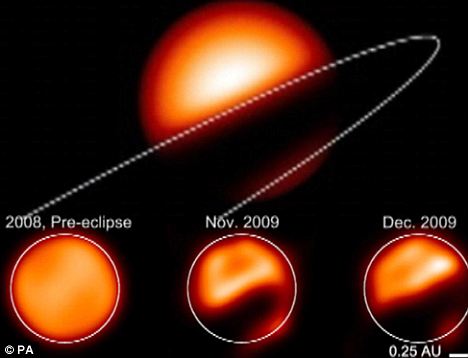
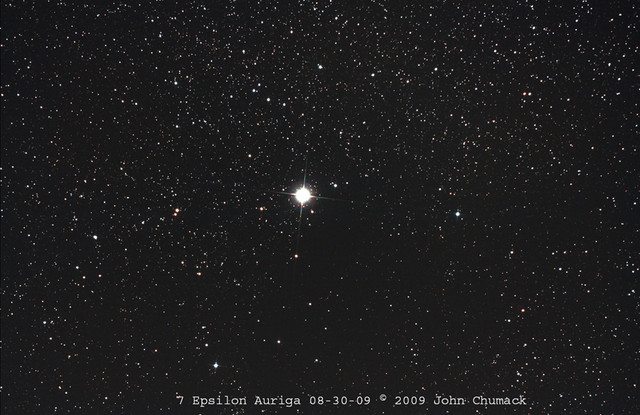
Epsilon Aurigae Auriga Apparent: 2.9 normally, 3.8 during eclipse; Absolute: -6.0 ~2000 light years (ly) Right Ascension: 05h 01m 58.1s; Declination: +43° 49’ 24” AAVSO: Epsilon Aurigae Citizen Sky: Epsilon Aurigae
Epsilon Aurigae is an eclipsing binary. One part is a white giant, and the other appears to be a star shrouded by a dark cloud of dust. In the middle of this cloud, there is a clearing where the star probably is, so during an eclipse, the system appears momentarily brighter as this clearing passes over the giant. An observation project of Epsilon Aurigae took place from 2009-2011.
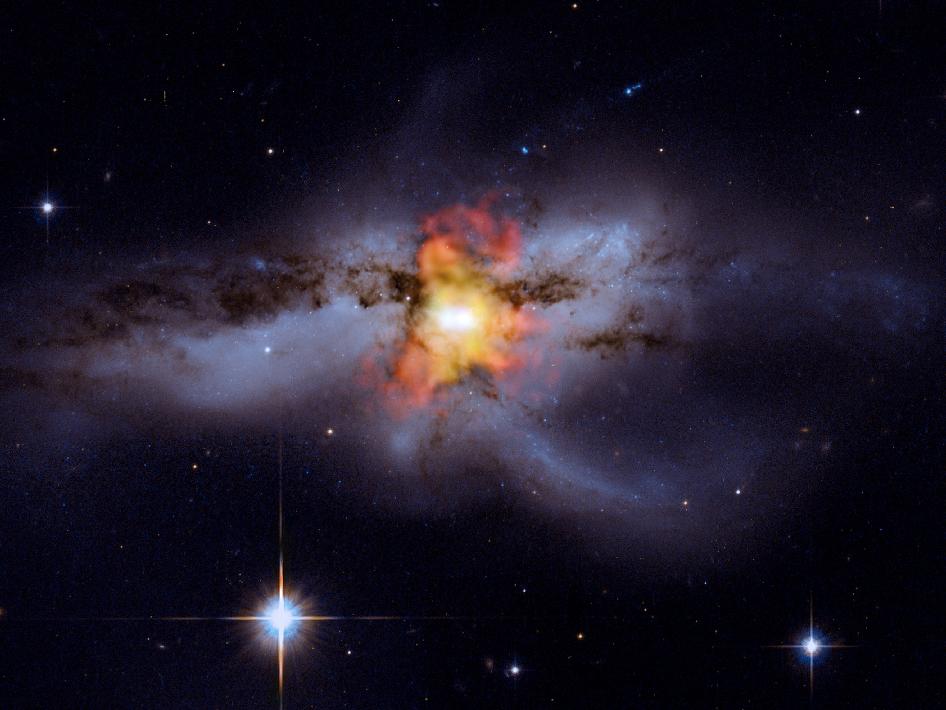
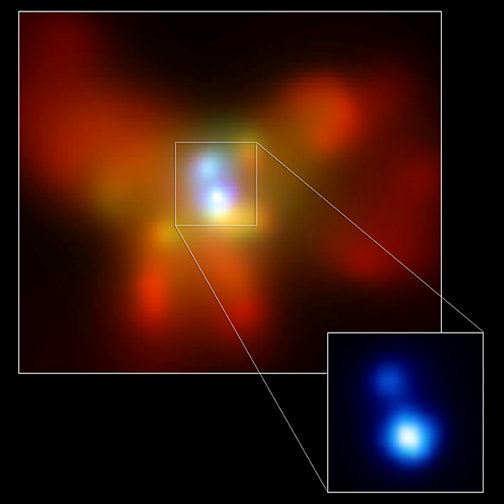
NGC 6240 (IC 4625, UGC 10592, PGC 59186, VV 617) Ophiuchus Apparent: 12.8 ~330 million ly Right Ascension: 16h 52m 58.9s; Declination: +02° 24' 03" Chandra: NGC 6240 NASA APOD: NGC 6240
NGC 6240 is an extremely luminous infrared galaxy (ULIRG). It is the result of two smaller galaxies colliding to form one large galaxy with two nuclei and an irregular shape. Possible hypotheses for the high infrared emission are intense star formation or the presence of one or two AGNs.
3C 321 Serpens ~1.4 billion ly Right Ascension: 15h 31m 42.7s; Declination:: +24° 04’ 25.00" Chandra: 3C 321 Space.com: 3C 321
3C 321 is a binary system of galaxies. One of the galaxies is directing a large jet of energy at its companion. It is nicknamed the “Death Star Galaxy” and it is theorized that the galaxy with the jet contains a supermassive black hole. It was discovered in 2007.
Centaurus A (NGC 5128, Arp 153, PGC 46957, Caldwell 77, 4U 1322-42) Centaurus Apparent: 6.84 ~15 million ly Right Ascension: 13h 25m 27.6s; Declination: -43° 01’ 09” SEDS: Centaurus A Solstation.com: Centaurus A
Cen A is one of the closest radio galaxies containing an AGN to Earth. It is the fifth brightest galaxy in the sky, although it is mostly only observable from the Southern Hemisphere. It is slowly consuming another spiral galaxy, causing rapid star formation, helping the radiation coming from the nucleus. The supermassive black hole at the center sends out jets of X-rays and radio waves in which the inner parts are moving at one half of the speed of light.
Stephan's Quintet (HGC 92, Arp 319, VV 288) Pegasus Apparent: 13.9 300-370 million ly Right Ascension: 22h 35m 57.5s; Declination: +33° 57’ 36” Chandra: Stephan's Quintet NASA APOD: Stephen's Quintet
Stephan's Quintet is a visual grouping of five galaxies. Four of the galaxies are in a compact group, and collisions have altered the form of the galaxies. Eventually, the four will likely merge into one large galaxy. The collisions have caused emissions of both x-rays and molecular hydrogen. The four than are physically interlocked are NGC 7317, NGC 7318a, NGC 7318b, and NGC 7319. NGC 7320 is not actually part of the interacting cluster but is a foreground object in the same area as the other galaxies. The galaxies NGC 7335, NGC 7336, and NGC 7337 in the NGC 7331 group, or Deer Lick Group, was used to determine this. Occasionally, the tidal forces cause NGC 7318b to emit huge shock waves of X-rays. It is also the brightest member of the group with an apparent magnitude of 13.9. NGC 7319 is classified as a Type 2 Seyfert galaxy.
MACSJ0717.5+3745 Auriga Right Ascension: 07h 17m 31.00s; Declination: +37° 45’ 39.60” Chandra: MACSJ0717.5+3745
MACSJ0717.5+3745 (MACSJ0717 for short) a galaxy cluster where four separate galaxies have been involved in a collision. The collisions are caused by a stream of hot gas known as a filament that pours into the cluster. It is one of the most complex clusters ever studied and was discovered in 2003.
Bullet Cluster (1E 0657-56) Carina Right Ascension: 06h 58m 37.9s; Declination: - 55° 57’ 0” Chandra: Bullet Cluster NASA APOD: Bullet Cluster
The Bullet Cluster is a system of two colliding clusters of galaxies. It is one of the best examples of evidence for the existence of dark matter. In the collision, the stars mostly did not interact, but the gases and other matter were significantly altered. This other matter is hypothesized to be dark matter, and is supported by the supposed Modified Newtonian Dynamics that explains the lensing phenomenon in the cluster. It is one of the hottest known clusters of galaxies.
Perseus A (NGC 1275, PGC 12429, UGC 2669, Caldwell 24, 3C 84, QSO B0316+413) Perseus Apparent: 12.6. Right Ascension: 03h 19m 48.1s; Declination: +41° 30’ 42” NASA APOD: Perseus A Hubble Heritage: Perseus A
Perseus A is a Type 1.5 Seyfert galaxy, which signifies that both broad and narrow lines on the emission spectrum are present, but there are less pronounced broad lines than a Type 1 Seyfert galaxy. It consists of two galaxies, one in the center and another that lies in front of it. Long filaments of gas stretch out from the system.
SN 2006gy Perseus Peak Apparent: 14.2 Right Ascension: 03h 17m 27.10s; Declination: +41° 24’ 19.50” Chandra: SN 2006gy NASA APOD: SN 2006gy
SN 2006gy was an extremely energetic supernova that reached an extremely high luminosity level. The large size of the star caused it to gain energy in its core, eventually causing it to be blown apart violently. This type of supernova is sometimes referred to a hypernova, and it compared to the star Eta Carinae in the Milky Way.
SN 1996cr Circinus Right Ascension: 14h 13m 10.05 s; Declination: -65° 20’ 44.8” Chandra: SN 1996cr
SN 1996cr is a powerful supernova that was noticed in a Chandra image after it was taken, and was widely studied afterward. The star exploded between 1995 and 1996, but was not discovered until 2001. It is of interest because it is located in an active galaxy with a growing supermassive black hole and rapid star formation.
NGC 4603 (PGC 42510) Centaurus Apparent: 12.3 Right Ascension: 12h 40m 55.2s; Declination: -40° 58’ 35” NASA APOD: NGC 4603 HyperPhysics: NGC 4603
NGC 4603 is a large spiral galaxy. It is the most distant galaxy in which Cepheids have been used to determine the distance to the galaxy. Using this distance and determining recession velocity, it has served as a benchmark for determining the Hubble constant (70 km/sec/Mpc ±10%).
NGC 7771 (VV 2002) Pegasus Apparent: 12.9 Right Ascension: 23h 51m 25.0s; Declination: +20° 06’ 49” NASA APOD: NGC 7771
a large spiral galaxy in close proximity to two other galaxies. This trio of galaxies is named the NGC 7771 group after its largest member, a spiral, the three galaxies, NGC 7769-7771, have passed by each other closely and will eventually form one huge galaxy. It is considered an accurate representation of the formation of the Milky Way. Dusty nebulae in front of the group obstruct clear viewing.
NGC 2623 (Arp 243) Cancer Apparent: 13.9 Right Ascension: 08h 38m 24.1s; Declination: +25° 45’ 01” NASA APOD: NGC 2623 Hubble: NGC 2623
a system of two or more interacting galaxies. The galaxies have formed one common nucleus, but there are two strands of stars branching out from the galaxy, indicating a merger has taken place.
JKCS041 Chandra: JKCS041
An extremely distant galaxy cluster, about 10.2 billion years away. This object may help scientists better understand how the universe developed at an early age.
Messier 77 (NGC 1068, UGC 2188, PGC 10266, Arp 37, 3C 71) Chandra: Messier 77 Universe Today: Messier 77
One of the nearest and brightest galaxies containing a supermassive black hole. Million-mile per hour wind from the black hole shapes the galaxy.
H2356-309 Chandra: H2356-309
A collection of extremely distant warm hot intergalactic medium, some of the “missing matter” in the nearby universe.
  • Basic note sheet for the 2011 DSOs, intended for use when asked to quickly identify things, or for those new to the event.
2010 DSOs

-**is part of a special viewing campaign this year and will be included up to at least 2011.

See Also

Astronomy
Astronomy/Stellar Evolution
Astronomy/Variable Stars
Astronomy/Star and Planet Formation
Astronomy/Type Ia Supernovae
Astronomy/Type II Supernovae
Astronomy/Exoplanets

Links

Basic note sheet for the 2011 DSOs
SIMBAD Astronomy Database for DSOs