Ah, well I never knew the constant's units. Thanks. So to confirm- This would be in the infared range.
Do I get next question? If so, I'll just let someone else do it (If that is allowed. I can't think of one rn).
Re: Remote Sensing C
Posted: March 2nd, 2017, 4:11 am
by Xuax
hearthstone224 wrote:Ah, well I never knew the constant's units. Thanks. So to confirm- This would be in the infared range.
Do I get next question? If so, I'll just let someone else do it (If that is allowed. I can't think of one rn).
It would be in the infrared (LWIR). I'll ask the next question.
What temperature must a blackbody with 5.54* 10^-28 W × sr-1 × m-3 spectral radiance and 550 nm wavelength be at?
Re: Remote Sensing C
Posted: March 2nd, 2017, 5:50 am
by hearthstone224
Xuax wrote:
hearthstone224 wrote:Ah, well I never knew the constant's units. Thanks. So to confirm- This would be in the infared range.
Do I get next question? If so, I'll just let someone else do it (If that is allowed. I can't think of one rn).
It would be in the infrared (LWIR). I'll ask the next question.
What temperature must a blackbody with 5.54* 10^-28 W × sr-1 × m-3 spectral radiance and 550 nm wavelength be at?
Alright. I have an idea, but I'm confused on how we would use the wavelength information.
Stefan-Boltzmann's law states that L = A*alpha*T^4, where L is the luminosity, A is the surface area, alpha is the constant 5.670*10^-5 and then T is what we are looking for. We only lack the surface area information here.
How would we figure that out? Am I on the right track?
Re: Remote Sensing C
Posted: March 2nd, 2017, 5:59 am
by Unome
hearthstone224 wrote:
Xuax wrote:
hearthstone224 wrote:Ah, well I never knew the constant's units. Thanks. So to confirm- This would be in the infared range.
Do I get next question? If so, I'll just let someone else do it (If that is allowed. I can't think of one rn).
It would be in the infrared (LWIR). I'll ask the next question.
What temperature must a blackbody with 5.54* 10^-28 W × sr-1 × m-3 spectral radiance and 550 nm wavelength be at?
Alright. I have an idea, but I'm confused on how we would use the wavelength information.
Stefan-Boltzmann's law states that L = A*alpha*T^4, where L is the luminosity, A is the surface area, alpha is the constant 5.670*10^-5 and then T is what we are looking for. We only lack the surface area information here.
How would we figure that out? Am I on the right track?
I suspect Xuax meant to say W x sr-1 x m-2 which is the correct unit for spectral radiance. Somehow you would have to get rid of the steradian (maybe multiply by the number of steradians per sphere?) and then use the flux form of Stefan-Boltzmann's Law: . As far as I know, the wavelength is unneeded for the problem (though I guess you can alternatively solve it using Wien's Law?)
Re: Remote Sensing C
Posted: March 2nd, 2017, 11:47 am
by Xuax
Unome wrote:
hearthstone224 wrote:
Xuax wrote:
It would be in the infrared (LWIR). I'll ask the next question.
What temperature must a blackbody with 5.54* 10^-28 W × sr-1 × m-3 spectral radiance and 550 nm wavelength be at?
Alright. I have an idea, but I'm confused on how we would use the wavelength information.
Stefan-Boltzmann's law states that L = A*alpha*T^4, where L is the luminosity, A is the surface area, alpha is the constant 5.670*10^-5 and then T is what we are looking for. We only lack the surface area information here.
How would we figure that out? Am I on the right track?
I suspect Xuax meant to say W x sr-1 x m-2 which is the correct unit for spectral radiance. Somehow you would have to get rid of the steradian (maybe multiply by the number of steradians per sphere?) and then use the flux form of Stefan-Boltzmann's Law: . As far as I know, the wavelength is unneeded for the problem (though I guess you can alternatively solve it using Wien's Law?)
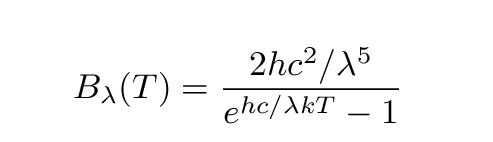
The question was supposed to be about the Planck function. When the function is expressed as Bλ(λ,T), the unit is W x sr-1 x m-3. That is a unit of spectral radiance. If you know the spectral radiance and the wavelength, you can find the temperature.
Re: Remote Sensing C
Posted: March 2nd, 2017, 12:05 pm
by Xuax
Use the form of Planck´s function tλ(λ,L) to find the answer.
Re: Remote Sensing C
Posted: March 17th, 2017, 5:02 am
by jonboyage
I didn't realize this wasn't answered yet...
266.8 Kelvin?
Re: Remote Sensing C
Posted: March 27th, 2017, 6:50 pm
by Asphalt
zyzzyva980 wrote:
bhavjain wrote:Short Event Description: Participants will use remote sensing imagery, data and computational process skills to complete tasks related to climate change processes in the Earth system.
What is the difference between active and passive sensing?
This is a great question to start with because it will be on literally every Remote Sensing test you take this year. Know the answer to this question.
Passive: Detects natural energy reflected/Emitted from an observed scene
Active: Detects own radiation reflected back to instrument
Re: Remote Sensing C
Posted: March 27th, 2017, 6:58 pm
by Asphalt
Xuax wrote:Use the form of Planck´s function tλ(λ,L) to find the answer.
Is this what i would do?
Planck Quanta (Q) Equal to hv [variable( h ) constant equal to 6.63 x 10 to the negative 34th power] [J-s & v variable represents frequency in 1/s]
Planck Unknown Known: Frequency (v) wavelength Energy ( E )
if so how?
Re: Remote Sensing C
Posted: August 19th, 2017, 5:33 pm
by whythelongface
No. Planck's Function is:
So you would plug the values for B_λ and λ in and solve for T.
Sorry for being late, but I thought the thread needed reviving.