Re: Thermodynamics B/C
Posted: December 17th, 2018, 10:09 am
Reboot time?
specific heat of ice = 2.108 J/g*K
heat of fusion = 334 J/g
specific heat of water = 4.184 J/g*K
Treat the entire process as three separate processes (the ice warming up to its freezing point, the ice melting, and the water warming up to 23 degrees Celsius). Then you can calculate the change in entropy for each process and add them up to get the final answer.
Not to be that guy, but I'm pretty sure this question requires calculus. I don't think this question should be showing up here or on any tests at invitationals.Justin72835 wrote:Let's start this back up again.
A plastic cup of negligible heat capacity is filled with 300 grams of ice at a temperature of -10 degrees Celsius. The cup is then placed in a large room at a temperature of 23 degrees Celsius. After a significant amount of time, the ice inside the cup is completely melted and the water reaches the same temperature of the room. Assume that the room is large enough that its temperature does not change.
What is the total change entropy of the ice/water?
specific heat of ice = 2.108 J/g*K heat of fusion = 334 J/g specific heat of water = 4.184 J/g*KTreat the entire process as three separate processes (the ice warming up to its freezing point, the ice melting, and the water warming up to 23 degrees Celsius). Then you can calculate the change in entropy for each process and add them up to get the final answer.
Carpenter wrote:Not to be that guy, but I'm pretty sure this question requires calculus. I don't think this question should be showing up here or on any tests at invitationals.Justin72835 wrote:Let's start this back up again.
A plastic cup of negligible heat capacity is filled with 300 grams of ice at a temperature of -10 degrees Celsius. The cup is then placed in a large room at a temperature of 23 degrees Celsius. After a significant amount of time, the ice inside the cup is completely melted and the water reaches the same temperature of the room. Assume that the room is large enough that its temperature does not change.
What is the total change entropy of the ice/water?
specific heat of ice = 2.108 J/g*K heat of fusion = 334 J/g specific heat of water = 4.184 J/g*KTreat the entire process as three separate processes (the ice warming up to its freezing point, the ice melting, and the water warming up to 23 degrees Celsius). Then you can calculate the change in entropy for each process and add them up to get the final answer.
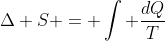


Now, using Wolfram Alpha or a sufficiently smart calculator to compute the integrals and sum everything together, I get
.
Correct me if I'm wrong, but shouldn't the entropy for the melting process be this instead?UTF-8 U+6211 U+662F wrote:Carpenter wrote:Not to be that guy, but I'm pretty sure this question requires calculus. I don't think this question should be showing up here or on any tests at invitationals.Justin72835 wrote:Let's start this back up again.
A plastic cup of negligible heat capacity is filled with 300 grams of ice at a temperature of -10 degrees Celsius. The cup is then placed in a large room at a temperature of 23 degrees Celsius. After a significant amount of time, the ice inside the cup is completely melted and the water reaches the same temperature of the room. Assume that the room is large enough that its temperature does not change.
What is the total change entropy of the ice/water?
specific heat of ice = 2.108 J/g*K heat of fusion = 334 J/g specific heat of water = 4.184 J/g*KTreat the entire process as three separate processes (the ice warming up to its freezing point, the ice melting, and the water warming up to 23 degrees Celsius). Then you can calculate the change in entropy for each process and add them up to get the final answer.
Have you heard of the hide functions?blueflannel27 wrote:Correct me if I'm wrong, but shouldn't the entropy for the melting process be this instead?UTF-8 U+6211 U+662F wrote:Carpenter wrote: Not to be that guy, but I'm pretty sure this question requires calculus. I don't think this question should be showing up here or on any tests at invitationals.
Code: Select all
[hide]title|hidden[/hide]
[spoiler]Hidden[/spoiler]
And
[Answer]hidden[/answer]hidden
hidden
Yes, that's right. As my physics teacher says, I was just testing to see if you were paying attention.blueflannel27 wrote:Correct me if I'm wrong, but shouldn't the entropy for the melting process be this instead?UTF-8 U+6211 U+662F wrote:Carpenter wrote: Not to be that guy, but I'm pretty sure this question requires calculus. I don't think this question should be showing up here or on any tests at invitationals.
[math]\boxed{491.90\ \frac{\textrm{J}}{\textrm{K}}}[/math].Yup, you got it. Someone else can answer UTF's next question.UTF-8 U+6211 U+662F wrote:Yes, that's right. As my physics teacher says, I was just testing to see if you were paying attention.blueflannel27 wrote:Correct me if I'm wrong, but shouldn't the entropy for the melting process be this instead?UTF-8 U+6211 U+662F wrote:
What do the triple point and critical point mean on a phase diagram? Why is the phase diagram of water special?[math]\boxed{491.90\ \frac{\textrm{J}}{\textrm{K}}}[/math].
Okay yes, but For the triple point, I would word it more clearly as where the solid, liquid, and gas phases coexist because a single object cannot be all three of them at the same time. Technically, critical point refers to any end point of a phase equilibrium curve, not just the one between liquids and vapors.JoeyC wrote:The triple point is where a material can be a solid, liquid, and gas all at once. The critical point is where the boundary between liquid and vapor ceases to exist.