Page 4 of 8

Re: Reach for the Stars B

Posted: December 12th, 2012, 11:34 am
by EastStroudsburg13
A video series for Reach for the Stars has been posted on Youtube:

Part 1
Part 2
Part 3
Part 4

If you're not sure where to get started, or want to make sure you're on the right track, these would be very helpful for you. Of course, to do very well, you'll have to do extra research outside of this, but these can give a nice platform.

Re: Reach for the Stars B

Posted: December 29th, 2012, 5:20 pm
by Nerdy One
:twisted: We're going to blow our rival out of the water if I get put on reach this year. did solar system seventh grade and got 1st @ state no problem. For some reason I'm only good with biotic subjects unless they have anything to do with space. Weird? ;)

Re: Reach for the Stars B

Posted: January 6th, 2013, 2:19 pm
by sciencepenguin9
Does anyone have any recommended books for Reach For The Stars? I'm new to this event, so I would appreciate it if the book has the very basics and more advanced stuff. Thanks! :)

Re: Reach for the Stars B

Posted: January 8th, 2013, 6:48 am
by foreverphysics
We use Audubon's Guide to the Night Sky for our most basic information and knowledge about the various constellations and mythologies. We also have a copy of the Encyclopedia of Astronomy. For your way more advanced, mathy needs, we use Carroll and Ostlie's Introduction to Astrophysics (although really, that shouldn't be necessary in Reach for the Stars).

But mostly, we use the Internet.

Re: Reach for the Stars B

Posted: January 9th, 2013, 11:28 am
by ajohn
This is my first time doing reach for the stars and will somebody please help me... uh.. you know... give me some help :D

Re: Reach for the Stars B

Posted: January 9th, 2013, 1:23 pm
by Cheesy Pie
Read a lot of comprehensive astronomy books. For everything else, INTERNET!!!!!!

Best.
Strategy.
EVER. :D

Re: Reach for the Stars B

Posted: January 12th, 2013, 8:46 pm
by havenbro
ajohn wrote:This is my first time doing reach for the stars and will somebody please help me... uh.. you know... give me some help :D
I would suggest the Peterson field guide to the stars and planets: Its more comprehensive than the Audobon Field Guide, but it doesn't fit in your pocket as well.
http://www.amazon.com/Field-Guide-Plane ... 0395934311
Its written by Jay Pasachoff, who really writes well about anything astronomy related (I love him)

I've also found that Wikipedia is more helpful for this event than it is others.

Re: Reach for the Stars B

Posted: January 24th, 2013, 7:05 pm
by MacBookMinus
I noticed that the rules say we need knowledge of how different DSO's and stuff look in different portions of the electromagnetic spectrum. I haven't found any good solid sources for that kind of stuff, or what exactly to look for in determining in whether a pic was taken in visible or infrared (just as an example). I hope this doesn't come off as rule clarification asking, because I'm not. I'm looking for resources.

Re: Reach for the Stars B

Posted: January 25th, 2013, 10:02 am
by foreverphysics
MacBookMinus wrote:I noticed that the rules say we need knowledge of how different DSO's and stuff look in different portions of the electromagnetic spectrum. I haven't found any good solid sources for that kind of stuff, or what exactly to look for in determining in whether a pic was taken in visible or infrared (just as an example). I hope this doesn't come off as rule clarification asking, because I'm not. I'm looking for resources.
Google images are your friend. My search strings usually look something like this:
"ngc 7000 infrared"
Or something similar. You'd be surprised at what you can come up with.
Also, Chandra's X-Ray Observatory is good for all your...*drumroll*...x-ray needs!

Re: Reach for the Stars B

Posted: January 25th, 2013, 10:35 am
by EastStroudsburg13
MacBookMinus wrote:I noticed that the rules say we need knowledge of how different DSO's and stuff look in different portions of the electromagnetic spectrum. I haven't found any good solid sources for that kind of stuff, or what exactly to look for in determining in whether a pic was taken in visible or infrared (just as an example). I hope this doesn't come off as rule clarification asking, because I'm not. I'm looking for resources.
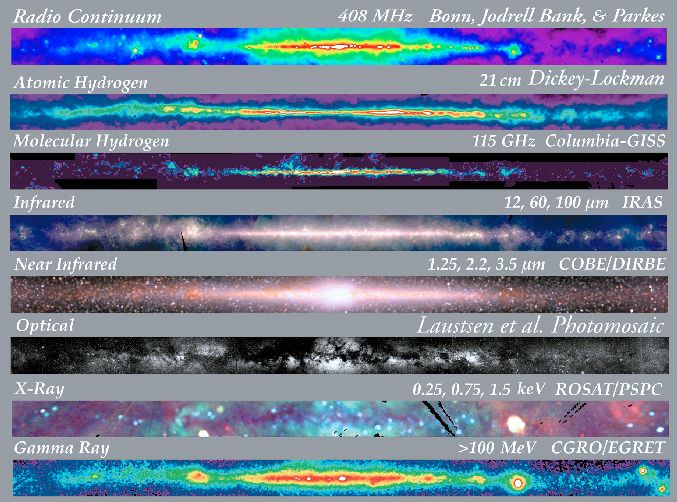
The best way to look for how different DSO's look in different wavelengths is, as forever said, through Google Images or different satellite sites like Chandra, but sometimes you may have trouble finding these images. Luckily, certain wavelengths tend to have certain characteristics. Take the image below, for example:
Image
Optical is what we see as visible light, so it'll appear as you'd expect it to. If it's a galaxy, you'll see the clouds that obscure some of the further stars.

Infrared senses heat, so the clouds aren't going to be as obstructive. Usually these images will appear redder than the optical image.

For Reach, you probably won't need to know the difference between Atomic and Molecular Hydrogen bands, and instead you just have to focus on Microwave. Microwave and radio are similar and their images look similar. In my experience, radio looks a little "fuzzier". Someone else might have a better way of explaining the difference.

On the other side, you have Ultraviolet, which isn't shown here. It generally appears purpler and bluer than optical.

X-Rays are the band in which Chandra takes images. These are areas of high energy, so stars, neutron stars, black holes, and other active areas appear bright, and not so much the inactive areas. You might see spots that are caused by X-ray emissions.

Finally, gamma rays are the highest energy. Objects here can look colorful like in radio, depending on the false color that the image is using, and they won't look very definite.

A lot of times, you just need to get a feel for guessing what wavelength an image was taken in. If you search for images taken in these wavelengths, you'll probably start getting a feel for what they usually look like. Normally, you won't get a lot of questions where you have to name the part of the spectrum in which an image was taken, so don't spend a ton of time on this. A general knowledge should serve you well.