The link that had powerpoint slides on it gave a very detailed, complex answer to your question, I'll attempt to simplify.
As balsaman said, the load that the compression members can take is directly related to the 'configured stiffness' of the beam(the technical term is second area moment of inertia). For most simple beams with parts at right angles(not like circular members or tubes) they can be broken into parts that are simple rectangles(for example, an I-Beam is a central support column, two flanges at top and bottom, and two other areas of nothing).
Now let's look at your compression member...
So I won't worry about the horizontal buckling of the member, it's most likely strong enough in the regard. The vertical buckling however is something to look at...
(This is a vast simplification, in reality your current member would take a lot more math to figure out, but this should do for comparison.)
According to the PDF balsaman posted, the formula for calculating this stiffness that comes from the configuration of the beam(for rectangular pieces, like this) is
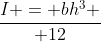
When applied to your compression member(since the bracing serves only to connect the two members in the horizontal plane) We get(1.968 is the width of the beam in inches)

The units really aren't that important, we're just comparing this member to a box-beam.
So your current compression member has a 'configured stiffness' in the y-axis of 0.0004883.
A box beam member is a little different beast... To calculate a box-beam, we can't simply use the equation like we did before, we have to subtract the part the doesn't actually exist. This gives us(Assuming the box is made of 1/16" side walls)
*(.25)^3 \over 12) - ((1.8435)*(.125)^3 \over 12) = 0.002262)
So the 'configured stiffness' of the same size box beam would be 0.002262, or 463% the strength of the solid member, because it's so much wider, and the width is part of the equation.
By Euler's buckling theorem, max force before buckling(the critical load) is proportional to not only the 'configured stiffness' but also the elastic modulus(E, which itself is related to density), and 1/exposed column length squared. In this case, the increase in 'configured stiffness' by switching to a box beam seems to be plenty to give you the increased max load(7.5 to 15kg), in fact, you could probably even use lower density(lower E) balsa and get away with it... but that'll take testing also.
This is what happens when I write long things.. I kinda loose track of what I meant to do... but I hope that more thoroughly answers your original question, and I hope you understand the math... I can be pretty bad at explaining things at times

Just remember that we don't have enough time or calculus skills to do the exact math, so this is all just rough comparisons...
Oh, and if someone could look over the theory and make sure this all makes sense... first time I did it I assumed his member was a solid piece 1.968x.25 inches in cross section, and I got that the box-beam was 88% percent the strength of the solid member, which makes sense, but, it doesn't make sense to model his member as a solid one and the box member as a tube, so I calculated his as a tube with a wall thickness on the long sides of 0(which is the same as 2 solid members on the sides), and got that the box beam was significantly stronger... so I don't know what I'm doing wrong(if anything at all)... Oh, and for some reason the math tags aren't working...