Page 17 of 21
Re: Astronomy C
Posted: April 22nd, 2018, 3:19 pm
by NePickers5
Okay I have more questions! Hehe

Anyway so say you had a problem like this:
Consider the following velocity curve for a binary star system for the questions.
Positive velocities are radially away from the observer. The stars in the system are separated by
2.17E10 m and the observer is in the plane of the orbit.
What is the recessional velocity of the system?
What is the period of the binary system?
What is the total mass of the binary system, in solar masses?
What is the orbital velocity of the more massive of the two stars?
What is the orbital radius of the more massive of the two stars, in m?
What is the mass of the more massive of the two stars, in solar masses?
So... pretend there is a velocity curve there, and the period is 3.25 days, and the recessional velocity is 225 km/s...
How would you find the other properties asked in the questions?
Re: Astronomy C
Posted: April 22nd, 2018, 3:25 pm
by astro12345
I'm pretty new to this event and am having some difficulty with binary star system calculations. Any help would be much appreciated.
If you are given only a radial velocity curve and the period of a system, how can you calculate the total mass of the system? Also, how can you calculate the semi major axis?
Re: Astronomy C
Posted: April 22nd, 2018, 4:17 pm
by Unome
astro12345 wrote:I'm pretty new to this event and am having some difficulty with binary star system calculations. Any help would be much appreciated.
If you are given only a radial velocity curve and the period of a system, how can you calculate the total mass of the system? Also, how can you calculate the semi major axis?

- replace circumference with

, take the sum of the peak radial velocities as the velocity in this equation, and solve for

. Summing the velocities beforehand simply bypasses solving for each object-barycenter distance separately and then adding them - this
is actually just the distance between the two objects. This answers your second question, which you can use to solve for the total mass with Kepler's 3rd law.
Re: Astronomy C
Posted: April 22nd, 2018, 4:25 pm
by jonboyage
NePickers5 wrote:Okay I have more questions! Hehe
Anyway so say you had a problem like this:
Consider the following velocity curve for a binary star system for the questions.
Positive velocities are radially away from the observer. The stars in the system are separated by
2.17E10 m and the observer is in the plane of the orbit.
What is the recessional velocity of the system?
What is the period of the binary system?
What is the total mass of the binary system, in solar masses?
What is the orbital velocity of the more massive of the two stars?
What is the orbital radius of the more massive of the two stars, in m?
What is the mass of the more massive of the two stars, in solar masses?
So... pretend there is a velocity curve there, and the period is 3.25 days, and the recessional velocity is 225 km/s...
How would you find the other properties asked in the questions?
astro12345 wrote:I'm pretty new to this event and am having some difficulty with binary star system calculations. Any help would be much appreciated.
If you are given only a radial velocity curve and the period of a system, how can you calculate the total mass of the system? Also, how can you calculate the semi major axis?
To calculate the total mass of the system, you can use this form of Kepler's Third Law:

where

is the semimajor axis in astronomical units,

is the period in years, and

is the mass of the system in solar masses. You get the semimajor axis from the given separation (2.17E10m) which you can convert to AU. You are also given the period in days, which you can convert to years.
For the other parts of the questions we need the radial velocity curve because we can determine what appears to be the maximum velocity of the smaller-amplitude star (the more massive one). In reality, this maximum velocity is just the "constant velocity" of the star because we are assuming that the stars have circular orbits and that we are in the plane of the orbit. This means we can determine the circumference of the orbit because we calculate the max velocity times the period. Once we have the circumference, we can determine the radius by

. Once we have this information, we can determine the mass of the larger star because we know

and

(we know

and
so we can figure out

) as well as

. We substitute and get
r_2)
. We isolate

and get
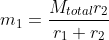
or
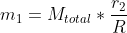
.
Hope this helped!
By the way, I started writing this before Unome posted so I didn't know he already answered this. Still, hopefully this (slightly) more in-depth answer helps with the intuition.
Re: Astronomy C
Posted: April 23rd, 2018, 1:42 pm
by NePickers5
jonboyage wrote:NePickers5 wrote:Okay I have more questions! Hehe
Anyway so say you had a problem like this:
Consider the following velocity curve for a binary star system for the questions.
Positive velocities are radially away from the observer. The stars in the system are separated by
2.17E10 m and the observer is in the plane of the orbit.
What is the recessional velocity of the system?
What is the period of the binary system?
What is the total mass of the binary system, in solar masses?
What is the orbital velocity of the more massive of the two stars?
What is the orbital radius of the more massive of the two stars, in m?
What is the mass of the more massive of the two stars, in solar masses?
So... pretend there is a velocity curve there, and the period is 3.25 days, and the recessional velocity is 225 km/s...
How would you find the other properties asked in the questions?
astro12345 wrote:I'm pretty new to this event and am having some difficulty with binary star system calculations. Any help would be much appreciated.
If you are given only a radial velocity curve and the period of a system, how can you calculate the total mass of the system? Also, how can you calculate the semi major axis?
To calculate the total mass of the system, you can use this form of Kepler's Third Law:
where
is the semimajor axis in astronomical units,
is the period in years, and
is the mass of the system in solar masses. You get the semimajor axis from the given separation (2.17E10m) which you can convert to AU. You are also given the period in days, which you can convert to years.
For the other parts of the questions we need the radial velocity curve because we can determine what appears to be the maximum velocity of the smaller-amplitude star (the more massive one). In reality, this maximum velocity is just the "constant velocity" of the star because we are assuming that the stars have circular orbits and that we are in the plane of the orbit. This means we can determine the circumference of the orbit because we calculate the max velocity times the period. Once we have the circumference, we can determine the radius by
. Once we have this information, we can determine the mass of the larger star because we know
and
(we know
and
so we can figure out
) as well as
. We substitute and get
. We isolate
and get
or
.
Hope this helped!
By the way, I started writing this before Unome posted so I didn't know he already answered this. Still, hopefully this (slightly) more in-depth answer helps with the intuition.
Okay so, I keep trying the equation for the total mass, and I keep getting 2.4... which is ~not~ the answer... so hehe if it wouldn't be too much, could you maybe walk me through it? I feel like such a child asking this, but I
am a literal child
Re: Astronomy C
Posted: April 23rd, 2018, 3:32 pm
by Unome
NePickers5 wrote:jonboyage wrote:omitted for brevity
Okay so, I keep trying the equation for the total mass, and I keep getting 2.4... which is ~not~ the answer... so hehe if it wouldn't be too much, could you maybe walk me through it? I feel like such a child asking this, but I
am a literal child
I'm getting a total mass of 38.5 solar masses.
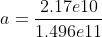
and

for the units you want, and plug into

.
On an unrelated topic, does anyone have any sources on why pulsar jets emit in radio as opposed to other spectral regions? I can't seem to find anything on this topic.
Re: Astronomy C
Posted: April 23rd, 2018, 6:00 pm
by jonboyage
Unome wrote:NePickers5 wrote:jonboyage wrote:omitted for brevity
Okay so, I keep trying the equation for the total mass, and I keep getting 2.4... which is ~not~ the answer... so hehe if it wouldn't be too much, could you maybe walk me through it? I feel like such a child asking this, but I
am a literal child
I'm getting a total mass of 38.5 solar masses.
and
for the units you want, and plug into
.
On an unrelated topic, does anyone have any sources on why pulsar jets emit in radio as opposed to other spectral regions? I can't seem to find anything on this topic.
You forgot to half the separation to get the semi major axis. Divide your answer by 8 Unome and then you get the answer: 4.818 solar masses.
Pulsars emit primarily in the radio portion of the spectrum due to synchrotron radiation. The magnetic field happens to cause electrons to emit radio waves when they change their velocity in that particular way when trapped in the magnetic field of the neutron star. Of course, synchrotron radiation isn’t limited to radio and can be detected even in the gamma range for certain objects.
Re: Astronomy C
Posted: April 23rd, 2018, 6:07 pm
by NePickers5
jonboyage wrote:Unome wrote:NePickers5 wrote:
Okay so, I keep trying the equation for the total mass, and I keep getting 2.4... which is ~not~ the answer... so hehe if it wouldn't be too much, could you maybe walk me through it? I feel like such a child asking this, but I am a literal child
I'm getting a total mass of 38.5 solar masses.
and
for the units you want, and plug into
.
On an unrelated topic, does anyone have any sources on why pulsar jets emit in radio as opposed to other spectral regions? I can't seem to find anything on this topic.
You forgot to half the separation to get the semi major axis. Divide your answer by 8 Unome and then you get the answer: 4.818 solar masses.
Pulsars emit primarily in the radio portion of the spectrum due to synchrotron radiation. The magnetic field happens to cause electrons to emit radio waves when they change their velocity in that particular way when trapped in the magnetic field of the neutron star. Of course, synchrotron radiation isn’t limited to radio and can be detected even in the gamma range for certain objects.
I am con
fuuuuused the practice test says the total mass was 14.36 solar masses but maybe it's wrong
that explains a lot
Re: Astronomy C
Posted: April 23rd, 2018, 6:16 pm
by jonboyage
NePickers5 wrote:jonboyage wrote:Unome wrote:
I'm getting a total mass of 38.5 solar masses.
and
for the units you want, and plug into
.
On an unrelated topic, does anyone have any sources on why pulsar jets emit in radio as opposed to other spectral regions? I can't seem to find anything on this topic.
You forgot to half the separation to get the semi major axis. Divide your answer by 8 Unome and then you get the answer: 4.818 solar masses.
Pulsars emit primarily in the radio portion of the spectrum due to synchrotron radiation. The magnetic field happens to cause electrons to emit radio waves when they change their velocity in that particular way when trapped in the magnetic field of the neutron star. Of course, synchrotron radiation isn’t limited to radio and can be detected even in the gamma range for certain objects.
I am con
fuuuuused the practice test says the total mass was 14.36 solar masses but maybe it's wrong
that explains a lot
I’m not sure where 14.36 comes from, but I don’t think I did anything wrong. :/
Re: Astronomy C
Posted: April 24th, 2018, 8:55 am
by alchzh
Yeah I'm kind of confused how we're somehow off by a factor of 3.