[img]http://www.liveindia.com/earth/Shrinking_Moon.jpg[/img]
1. Name this formation.
2. How did it form?
3. Name a terrestrial body that has these formations.
1. Scarps...?
2. Faulting/Erosion
3. Amenthes Rupes on Mars
Re: Solar System B
Posted: October 3rd, 2017, 2:21 pm
by dxu46
OrigamiPlanet wrote:
dxu46 wrote:
[img]http://www.liveindia.com/earth/Shrinking_Moon.jpg[/img]
1. Name this formation.
2. How did it form?
3. Name a terrestrial body that has these formations.
1. Scarps...?
2. Faulting/Erosion
3. Amenthes Rupes on Mars
All correct! Your turn.
Re: Solar System B
Posted: October 4th, 2017, 12:53 pm
by OrigamiPlanet
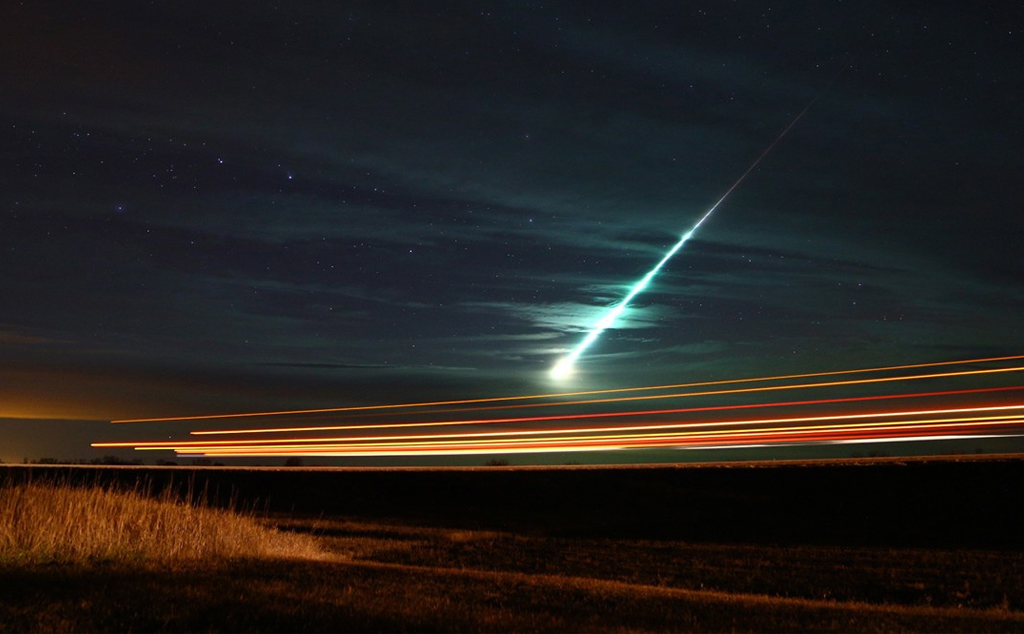
1. What is the streak of light?
2. Identify it's other counterparts (You should end up with two other ones).
3. A follow-up to two... how are they differentiated?
Re: Solar System B
Posted: October 4th, 2017, 7:17 pm
by dxu46
OrigamiPlanet wrote:
1. What is the streak of light?
2. Identify it's other counterparts (You should end up with two other ones).
3. A follow-up to two... how are they differentiated?
1. A meteor
2. Comet, Asteroid? Meaning unclear
3. What I've noticed: Comets are kind of blurry (they don't give a distinct image), with a trail left behind; asteroids are more distinct; and meteors are somewhere in between. (this may not be the real answer)
Re: Solar System B
Posted: October 5th, 2017, 12:27 pm
by OrigamiPlanet
dxu46 wrote:
OrigamiPlanet wrote:
1. What is the streak of light?
2. Identify it's other counterparts (You should end up with two other ones).
3. A follow-up to two... how are they differentiated?
1. A meteor
2. Comet, Asteroid? Meaning unclear
3. What I've noticed: Comets are kind of blurry (they don't give a distinct image), with a trail left behind; asteroids are more distinct; and meteors are somewhere in between. (this may not be the real answer)
That's right, but instead I wanted like meteorite and meteoroid, where a meteorite has already struck Earth while a meteoroid is not within Earth's atmosphere.
Re: Solar System B
Posted: November 19th, 2017, 5:45 pm
by bmd234
Since nobody has gone in a long time I'm gonna get it started again:
1. What did astronomer Giuseppe Piazzi discover?
2. What did Giuseppe Piazzi originally believe the object he discovered to be?
3. Explain the Titus-Bode Law and how it relates to the Asteroid Belt
4. What does AU stand for, and how many miles is in 1 AU.
5. Fill in the blanks. An AU is the distance from the _______ to the _______.
Re: Solar System B
Posted: November 27th, 2017, 12:33 am
by zannash
I answered bmd234's questions. 1. Asronomer Giuseppe Piazzi discovered the first known dwarf planet or asteroid, Ceres
2. A fixed star
3. The titus-bode law is a rule that gives the approximate distances from the sun. It allowed Bode to believe there was another planet between Mars and Jupiter.
4. An AU is also known as an astromomical unit. It has 92955807.3 miles in it.
5. An Au is the distance from the earth to the sun.
Re: Solar System B
Posted: January 2nd, 2018, 6:40 pm
by bmd234
zannash wrote:I answered bmd234's questions. 1. Asronomer Giuseppe Piazzi discovered the first known dwarf planet or asteroid, Ceres
2. A fixed star
3. The titus-bode law is a rule that gives the approximate distances from the sun. It allowed Bode to believe there was another planet between Mars and Jupiter.
4. An AU is also known as an astromomical unit. It has 92955807.3 miles in it.
5. An Au is the distance from the earth to the sun.
You're right, sorry I took so long to respond, I didn't see it because it wasn't a reply... whoOps... You're next!
Re: Solar System B
Posted: January 6th, 2018, 8:19 am
by NinjaKat748
So... um... when is the next question? I could do it if you guys want.
Re: Solar System B
Posted: January 7th, 2018, 1:28 pm
by zannash
1) List Kepler's laws.
2) What is a Bolide event?
3) In what part of the solar systems formation did solar winds sweep through inner solar system and strip of primordial atmospheres?
4) What did Edmond Halley do?
5) How far is Mercury from the sun?